

Housekeeping
This week, it’s Seattle again, and super late on the edition. They should be coming out much more frequently in the near future, now that I am back in the United States and working hard for the Seattle Disability Commission. Many of the materials I produce here are useful for my research, as well as mapping out relationship diagrams that assist in the Commission’s work, so many of the upcoming articles will be focused on utility as well as heady chin-scratching.
Weekly Roundup
If you’re interested in travel pics and a few lines of narrative, feel free to check out the Instagram - for now you need to request access, but I’ll admit anyone, so don’t be shy!
https://www.instagram.com/thelanyardboard/
Another thing to note, and a reason for delays since returning to the US: I have new, gainful employment! More on this to come, later.
New Favorite Sources
No new favorite sources to report this week! Check back next week!
Seattle City Council Committee Changes: Characterized (Again)
This week, I will be continuing the conversations about Seattle’s departments and offices, as well as its boards and commissions. To briefly recap, departments and offices are the top-line subdivision of the branches of The City of Seattle, with most of these being nested within the Executive (Mayor’s) branch.
The City of Seattle’s Municipal Budget provides for the employees of the City, employing a robust employment scheme that allots salaries and builds out jobs according to a mix of the Civil Service (more on this later) system, rules codified by the Seattle Municipal Code and directives given by the Mayor’s Office. In simple terms, departments and offices have employees that get paid real money. Where the money comes from, how people come up with “jobs” that need to be done by the city, and other things like that are irrelevant for this discussion, but may be good to explore later.
Boards and commissions, on the other hand, are mostly staffed by volunteers. There is budget from the City of Seattle assigned to them, either for operating or for the staff assigned by departments to support them. Boards and commissions are often centered around government functions that benefit from increased democratic input, and so are usually sheltered from monetary incentives. These functions are things like Civil Rights advocacy, City Planning, Ethics, or Transportation advocacy.
There are many different legal mechanisms and formats for the establishment of boards, commissions, departments and offices, which makes finding unifying threads and formats difficult to pin down. Fundamentally, this is because Seattle’s government is a living structure. There have been different councils at different points in time, different mayors with different priorities, and different populaces that have brought different things to a vote. Rather than a consistent set of axioms, it’s better to think of The City of Seattle as a restless mosaic, never getting too comfortable with one standard or another.
For the purpose of today’s analysis, we’ll look at one of the rare unifying threads between boards, commissions, departments and offices: City Council Oversight.
City Council Oversight
This article follows the conversation from TLB #3, where we talked about how departments and offices are distributed across 2026’s Seattle City Council standing committees. Like departments and offices, boards and commissions are assigned to each of the standing committees for the purposes of appointments and oversight. This also follows as a sequel to TLB #1, where we looked at changes in Seattle City Council Standing Committees from last cycle to this current cycle (2026).
In reality, this means that each City Council committee is responsible for a portfolio of offices, departments, boards and commissions that appear before council to provide input, report on activities and receive appointments. Between the 2024-2025 city council and the 2026-2027 city council, there were many changes in how city functions were bucketed across the different standing committees (more changes can be found here: ). This meant a lot of departments and offices changed which council committee they were reporting to, which is echoed across boards and commissions. It’s taken a moment to get the data together, but I’ve analyzed Seattle’s 71 active boards and commissions and the changes they experienced in council assignments.
Changes in Council Position Caseload
Between the 2024-2025 and the 2026-2027 city councils, we have seen about the same magnitude of change overall for boards and commissions as we have departments and offices.

A total of 23/43 (53%) of the observed departments and offices of The City of Seattle changed the council position of the chair of the committee they reported to. An example of this would be if they were reporting to a standing committee chaired by the district 1 councilmember in 2025, but in 2026 found themselves reporting to a standing committee chaired by the district 3 councilmember. The remaining 20/43 (47%) remained reporting to the committee chaired by the same council position. For most of those cases, they were reporting to the same councilmember themselves, unless a new councilmember was elected.
A total of 37/71 (52%) of the observed boards and commissions of The City of Seattle changed the council position of the chair of the committee they reported to. Similarly to the earlier example, this means at least thirty-seven separate boards and commissions experienced a change in who chairs the committee they report to at city council. The remaining 34/71 (48%) remained reporting to the committee chaired by the same council position.
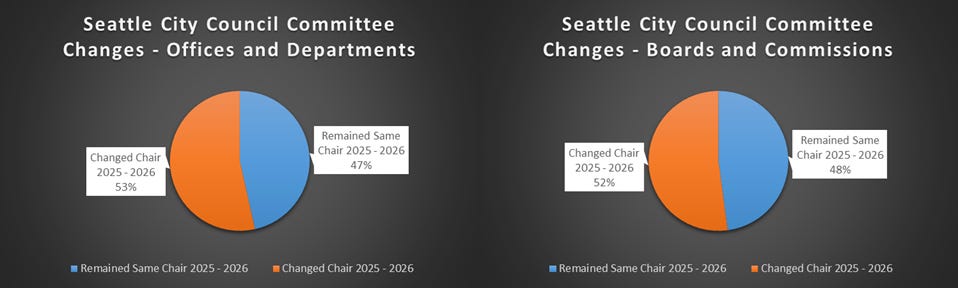
Despite the high magnitude of change (more than half of all entities having changed positions), the same relative proportion of ‘departments and offices’ and ‘boards and commissions’ have changed council committee positions. After performing a Chi-Squared test on the data (0.021 with 1 degree of freedom), the P-value is 0.885. Another way of wording this is that there’s an 88.5% chance that one would observe the proportion of changed-to-not-changed that we see in this data assuming randomness.
This makes it difficult to pin down the reason for the similarity – it could be that when committees were established in 2026, it was an essentially random reshuffle of both ‘departments and offices’ and ‘boards and commissions’. Fortunately, that’s not the only data we’re working with.
Departments and Offices Linked with Boards and Commissions
The way boards and commissions are supported by the City of Seattle is through the departments and offices. There are often staff that are assigned to be the liaisons between the boards and commissions and a specific department that does work specifically related to the board and commission’s scope of interest (E.G. Seattle Disability Commission liaises with the Office for Civil Rights). More on this can be found in TLB #10.
This means that each board and commission is tied to a specific office or department in The City of Seattle, and that when changes occur to the committees that departments and offices report to, those changes will likely occur for boards and commissions at the same time. To test this, we can check whether boards and commissions report to the same city council committee as their support department.
For this, the sample size will be dropped from ‘71’ to ‘55’ to account for the 16 boards and commissions that don’t have a specific support department and city council committee (this is mostly Preservation and Development Authorities).
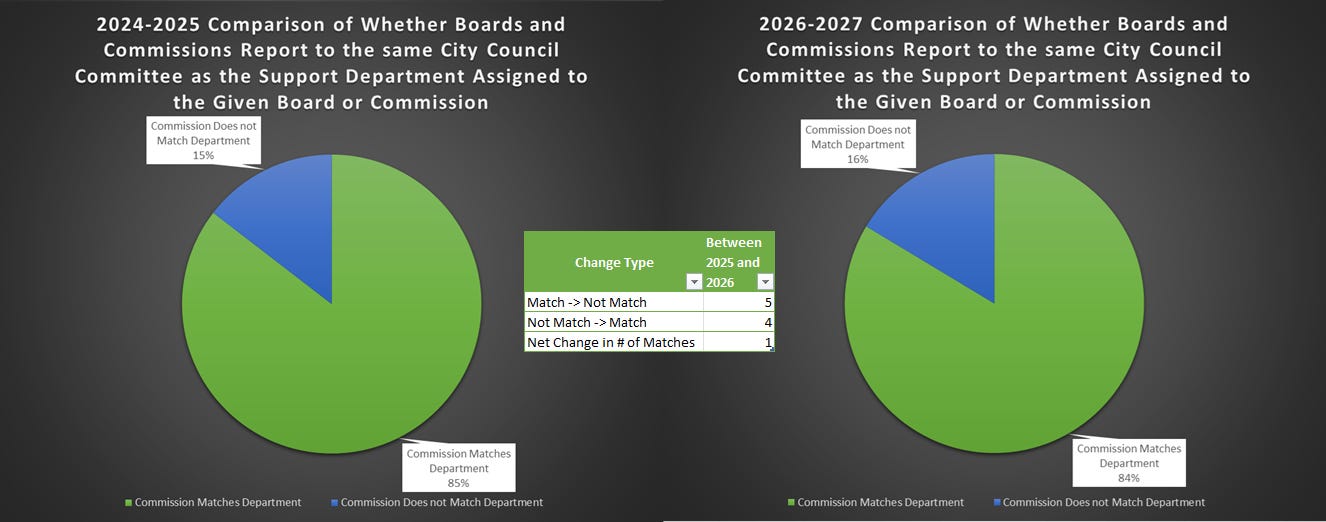
In the 2024-2025 Council, a total of 8/55 (15%) boards and commissions reported to a different standing committee than their support department, indicating that the majority of boards and commissions stick with their support department when it comes to which city council they report to. For the 2026-2027 Council, this number slightly increases to 9/55 (16%), but the majority of boards and commissions are aligned with their support department at council.

What is interesting about the changes though, is that despite the proportions being so similar (8/55 and 9/55 for 2024-2025 and 2026-2027 respectively), the total number of changes is much higher. Between these two sessions, five commissions changed from matching their support department to no longer matching, and four commissions changed from not matching to then being aligned with their support department.
These data make it difficult to pin down a definitive character for city council changes with respect to oversight portfolios, even though the oversight portfolios themselves have undergone large changes.
In the coming weeks, I’ll be drilling down into the data for the changes to identify not just a binary of ‘change vs. not change’, but a matrix of which offices, departments, boards and commissions have experienced specific changes. Some of this is just curiosity, but identifying these changes helps to understand the shifting landscape of Seattle’s civic attention, and where different subjects and bodies of work are shifting in terms of Seattle’s elected officials.
Closing Thoughts
Please forgive the density of this one! One major change that will be occurring in the coming week as well is the production of a style guide and Glossary that should make these articles a lot easier to read and more accessible, and cut down on the number of times I use “departments and offices” and “boards and commissions”.
We are also at the point where we have a more-or-less comprehensive list of all of the civic bodies that report to each of the standing committees at Seattle’s City Council. This coming week, I’ll be publishing a new resource (which will be sent to email, since it’ll be relatively meaty), comprising a list for each Standing Committee of the City Council of the civic bodies that report to it.
The best way to keep up with further conversations is to be a subscriber to The Lanyard Board, and to check out The Lanyard Board on social media.
The Lanyard Board is supported by readers like yourself. If you can, please support the project on Ko-Fi and tip the suggested amount of $2 for every month you feel a spark of enjoyment, insight or curiosity from The Lanyard Board.
Thanks for reading The Lanyard Board! Subscribe for free to receive new posts and support my work.