

Housekeeping
This week, it’s mostly about Seattle! We’re going back to articles that are more heavy with data and graphs that can be useful to City of Seattle stakeholders. The topic of this week is also timely, as it coincides with the final week of the Get Engaged program application cycle, which places youth up to 29 on a Board or Commission like the ones I’m looking at here. If you are one of the youngsters who are subscribed to TLB, please give it a look!
Weekly Roundup
If you’re interested in travel pics and a few lines of narrative, feel free to check out the Instagram - for now you need to request access, but I’ll admit anyone, so don’t be shy!
https://www.instagram.com/thelanyardboard/
New Favorite Sources
https://seattle.granicus.com/boards/w/2bd7623f61defffb/boards/7677 - The ‘canonical’ public list that contains all of the appointment information for each Board and Commission, including who specifically holds which seats, their terms, and seat numbers.
https://www.seattleymca.org/social-impact-center/youth-young-adults/employment-education/get-engaged-boards-commissions - Information about the Boards and Commissions supported by the YMCA’s “Get Engaged” program.
New Resources
This section will provide links to resources such as infographics that have been produced in the past week that are useful for understanding, mapping or working with City of Seattle stuff, broadly.
Resource: Active Boards and Commissions (2026) by Alphabetical Order

Comprehensive (Active) list and diagram of Boards and Commissions in the City of Seattle.
Organization Structure - Seattle Part II
Last time, I talked about the way the City of Seattle works as an employer and as a public organization that hires civil servants to carry out functions that are needed to accomplish ‘municipal governance’ in all of its forms.
The City of Seattle hires more than 10,000 people across its 4 branches and 42-ish offices and departments. Offices and departments are great tools for administration, because they can organize projects and workflows that manage and deliver resources and programs to the people who live in Seattle. They are also OK tools for gathering public input and feedback, as many employees and departments are trained to collect feedback actively through the individual programs that they administer.
There’s somewhat of an open question though, if feedback is collected at the point of service delivery - what happens when there’s a service people need that doesn’t currently exist? What do you do when social problems emerge that aren’t already preempted by the current programs and services of the City of Seattle?
There are a lot of ways to answer that question, and many Offices and Departments take this problem very seriously. The Seattle Department of Neighborhoods, Office of Emergency Management, Seattle Parks and Recreation and Seattle Department of Transportation, among some, have community outreach teams that collect program-specific and general-issue feedback from Seattle residents.
Direct action also has a large part to do with what rises to the level of administrator awareness. Protests and demonstrations that are well-attended and have high visibility sometimes skip all of the normative exploratory steps and reach the Mayor’s Office or City Council in a way that creates immediate policy or programmatic change.
Somewhere between direct community action and institutional problem-exploration is where Seattle’s Boards and Commissions sit. Many Boards and Commissions are established as a reaction to community action, to give an institutionally “legitimate” pathway to raise issues relevant to a specific community or subject to the level of policymakers and administrators. At its most suspicious form, it co-opts grassroots energy and constrains it by putting it into a Roberts-rules-of-order box. At its most useful form, it creates a vessel that allows communities to amplify their voices in a form that is tempered by genuine subject matter expertise and institutional buy-in.
Boards and Commissions
If it was difficult to taxonomize Seattle’s Branches, Departments, Offices, Divisions, etc., then it’s down-right impossible to do that for Seattle’s Boards and Commissions. Their unifying theme (which is true for all but two, but more on that later) is that all of them are overseen by and their appointments confirmed by the City of Seattle City Council. Some are over a century old, some are only a year old, and they are all established by legislation that looks slightly different.
Some of them have quasi-judicial powers that allow them to make legally binding decisions, some of them are narrowly-tailored to oversee levies, and most are advisory in nature (which runs the gambit from ‘we’ll take that into consideration’ to ‘you’re the experts, you tell us what to do.’ in how they operate).
Some of them are called boards, some of them are called commissions, some are committees, some are councils - the actual name of each does not necessarily give the reader any insight as to what they entail.
All of them are staffed with lovely people. Sometimes there are requirements (such as expertise in a field) to be a member of a Board or Commission, but the most common requirement is living or working in Seattle. When I say they are ‘staffed’ with lovely people, I don’t mean to confuse the reader - in the vast majority of cases, the people who serve on Boards and Commissions are doing so on a volunteer basis and aren’t compensated directly for the labor they put into the work. This often means that the people who serve are doing so out of a sense of civic duty, but also means that capacity can vary wildly from commissioner-to-commissioner.
Types of Boards and Commissions
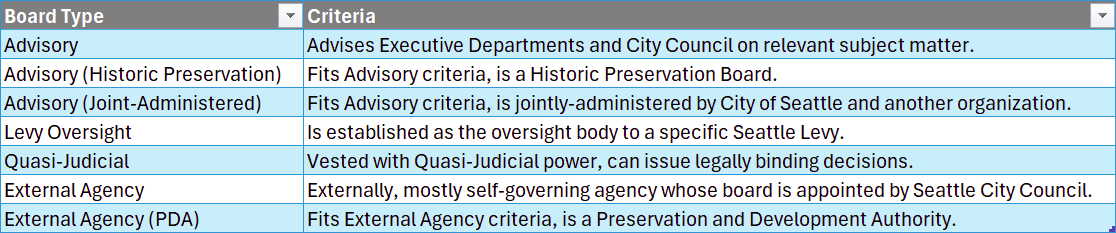
The following is, for the sake of our analysis, the model for categorizing boards and commissions. Take it with a grain of salt, because there are edge cases that stretch the boundary, especially with Advisory and Quasi-Judicial bodies.
Advisory Boards and Commissions
A good example of these would be those that are supported by Seattle’s Office for Civil Rights - the Seattle Disability Commission, Human Rights Commission, LGBTQ Commission and Women’s Commission. These are commissions that serve to advise the Mayor’s Office and City Council on specific subject matter related to issues of Civil Rights, and create city-wide ‘connective tissue’ related to their subjects (e.g. Disability Commission being able to connect with ADA coordinators from multiple Seattle Departments).
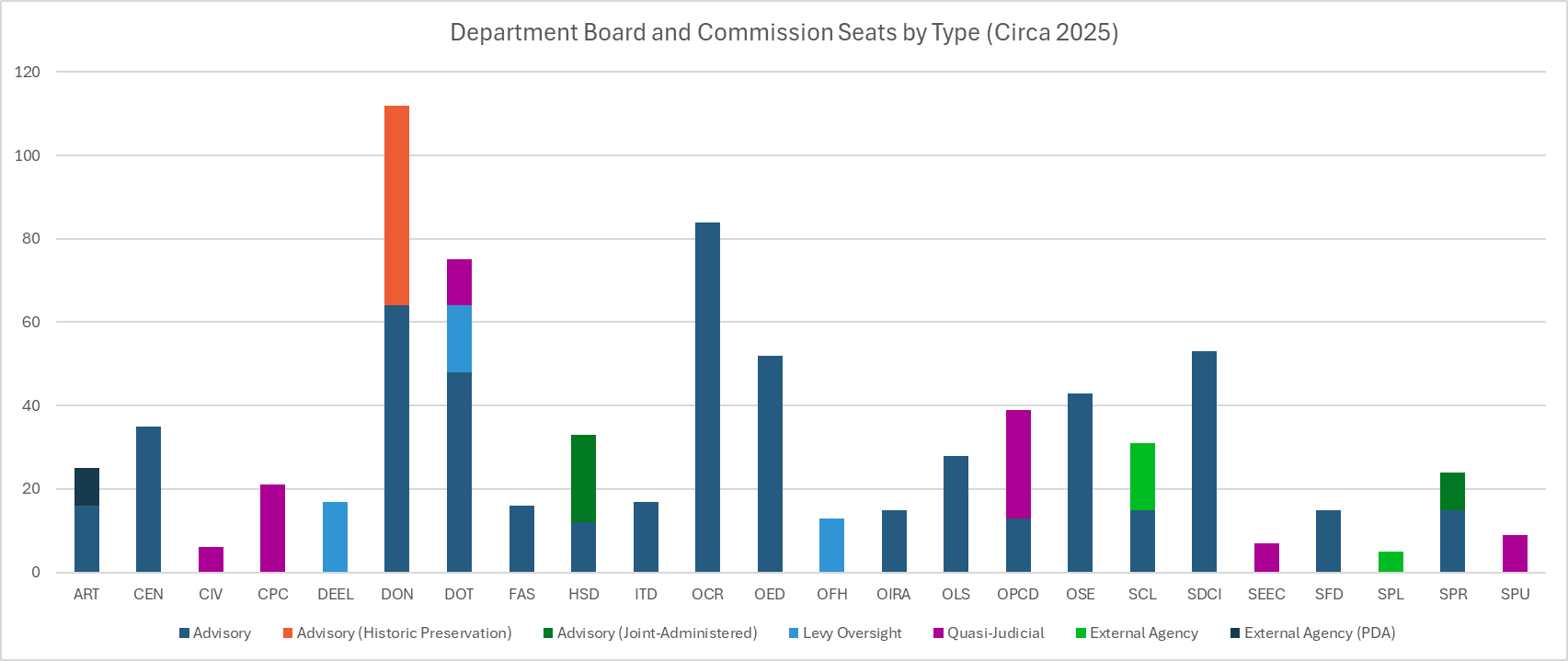
Advisory Boards and Commissions are the most common, accounting for 36 out of 71 active Boards and Commissions, and 44/71 when accounting for Historic Preservation Boards and Joint-Administered Boards and Commissions.
Historic Preservation Boards are a specific form of Advisory Boards and Commissions which get their own category because they share a lot more in common with one another than they do with the rest of the corpus of Advisory Boards and Commissions.
Joint-Administered Boards and Commissions include two edge cases that are administered partially by the City of Seattle, and partially by an external organization, giving them different characteristics from other Advisory Boards and Commissions.
Levy Oversight Committees
Seattle has a few massive levies that fund education, housing and transportation in addition to the Seattle general fund. These levies, in large part because they are voted on by the public, often have mechanisms baked in for oversight by Seattle residents to ensure that the funds are being spent responsibly and in-line with what voters agreed upon.
There are only three currently - the Families, Education Preschool and Promise Levy Oversight Committee, the Housing Levy Oversight Committee and the Levy to Move Seattle Oversight Committee.
Quasi-Judicial Boards and Commissions
These are probably the Boards and Commissions vested with the most power to govern. They are defined by their ability to exercise some quasi-judicial function that is baked into the ordinance that created them.
There are eight Boards and Commissions that are categorized as Quasi-Judicial, and many of them have staff assigned to them specifically by the City of Seattle. The Civil Service Commissions, the Community Police Commission and the Seattle Ethics and Elections Commission have department/office-level entities established purely to support the commissioners that serve on them, creating some confusion when mentioning the name of the commission. Saying “Civil Service Commissions” could refer to the department that is staffed by City of Seattle employees to support the commission, or it could refer to the commission itself. That is, unfortunately, just the way that things are, and I will try to be explicit when talking about either of them.
External Agency Boards and Commissions
There are nine non-PDA External Agency Boards and Commissions, and nine PDA (Preservation and Development Authority) Boards and Commissions in the City of Seattle. The City of Seattle has a good number of Boards and Commissions that liaise with the City of Seattle’s department staff, but which are functionally external organizations whose leadership or management boards are confirmed by Seattle City Council.
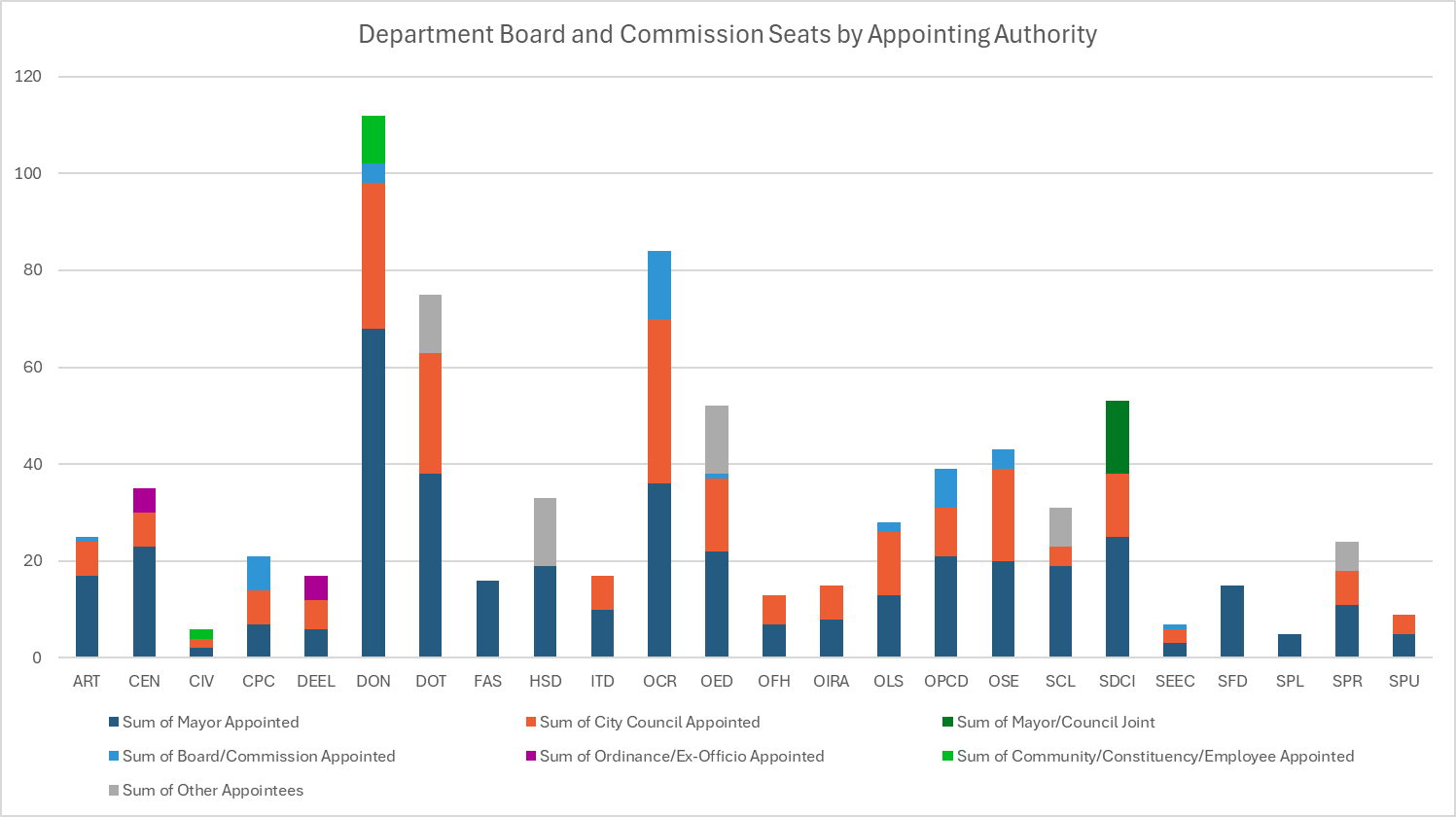
One interesting feature of External Agency Boards and Commissions is that the appointment authority for most seats in this category is either the Mayor or some special mechanism (not Mayor/Council/Commission appointed).
Preservation and Development Authorities are public corporations that are established to oversee, preserve and develop specific (often historically significant) development projects throughout Seattle. Being public corporations, they have a lot of similarities that make it convenient to have a sub-category dedicated to them.
Boards and Commissions Appointing Authorities
Each person who sits on a Board or Commission had to have been appointed to become a member. When a Board or Commission is established by ordinance, the ordinance lays out what the criteria are for appointing members.
Some ‘seats’ on the Boards and Commissions are pre-determined, and are ‘ex-officio’. Sometimes, members of City Council, directors of departments or other officials will automatically have a seat on the Board or Commission that they automatically fill or send a delegate to fill.
Other seats are appointed by boutique mechanisms that just heavily depend on the type of Board or Commission. One example is that the Pacific Hospital Preservation and Development Authority has one seat appointed by the King County Executive, and 4 by the PHPDA Council.
Most seats, however, fall under three categories, and in many of the Advisory Boards and Commissions, there is a roughly even balance of these three:
Mayor-appointed (Mayor’s Office nominates a member)
Council-appointed (City Council nominates a member)
Board/Commission-appointed (The Board or Commission votes to nominate a member)
This can serve as a ‘checks-and-balances’ system within the City of Seattle government, whereby the only voices heard from aren’t strictly in-line with the Mayor’s priorities or City Council’s priorities, but more closely resemble the organic priorities of the communities that members come from.
Boards and Commissions Support Departments
One linguistic tick that can be hard to get rid of when talking about Seattle Boards and Commissions is to say that a given body is “within” a department of the City. It is easy to say that the Seattle Disability Commission is in OCR, but that wouldn’t be accurate, and runs the risk of confusing the mission of the Commission.
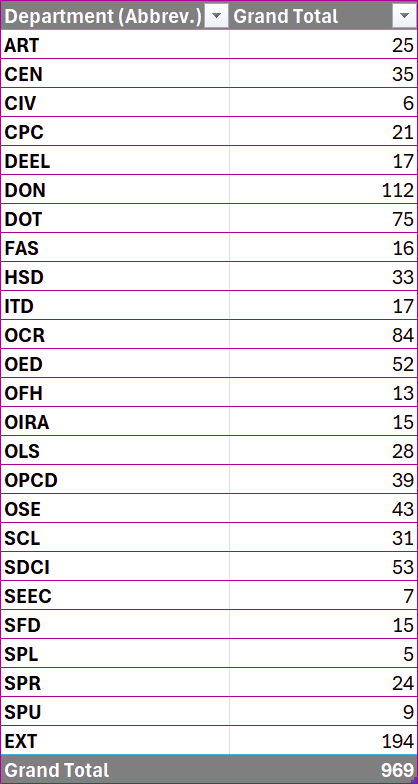
Boards and Commissions are intended to be independent bodies, so while they often have close connections to their support department, it’s more of a liaison relationship than a command relationship. More than 20 Seattle Offices and Departments support Boards and Commissions, with an uneven distribution of both total number of seats and total number of Boards and Commissions across these departments.
Boards and Commissions Council Committees
Like Departments and Offices, Boards and Commissions are each assigned to be overseen by, and have appointments confirmed by, a standing committee at Seattle City Council. We already have talked about what the 2026 slate of Committees and their presiding CMs are, but I haven’t received data yet on which Boards and Commissions appoint to each.
In 2025, the spread looked like this:
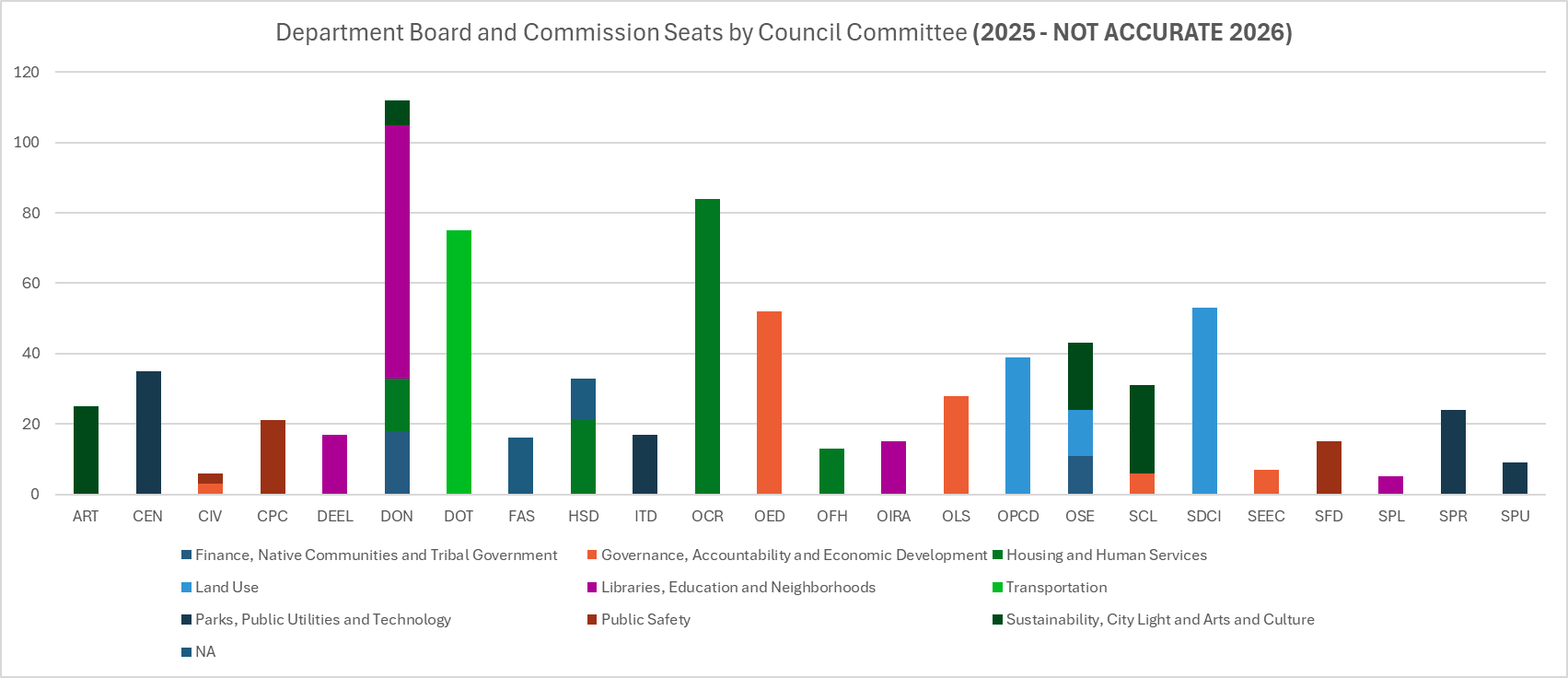
There are a number of instances in the past iteration of Council’s standing committees where a department will support multiple boards or commissions that report to different standing committees. This means it’s not always the case that a board or commission will report to the same standing committee their support department does.
I will create a new resource page with the updated distribution once I have it, but there are likely to be a few pretty interesting changes.
What good is any of this?
Seattle Boards and Commissions are interesting bodies within the city. To go back to a point earlier about the blurry boundaries between Advisory and Quasi-Judicial Boards and Commissions, there are some Advisory commissions that adopt or evolve quasi-judicial functions.
A good example of this would be the Human Rights Commission, which has power vested in it by the Office for Civil Rights which allows it to conduct appeals hearings for discrimination in the areas of employment, housing and public accommodations. Another example is that the Seattle Renters’ Commission is the appointing authority for most of the seats of the Seattle Social Housing Preservation and Development Authority’s board.
In some cases, the work being done by Boards and Commissions creates the groundwork or the demand for new City of Seattle Departments and Offices. In these cases, functions are passed back-and-forth as part of Department reorganizations, as was the case with the Seattle Planning Commission.
The conclusion I have come to is that Seattle’s Boards and Commissions, apart from being good ways for individuals to become civically engaged and gain greater context about the city they live in, are vessels. They are bodies which can hold governance functions without necessarily being limited or governed in the same way that city departments and staff are.
I have a long way to go before I have fleshed out exactly how these bodies operate in the ecosystem of Seattle’s governance, but I’ve identified a few of the mechanisms and have a good basis for exploring edge cases and identifying broad trends. As I get further into the study of Haiphong, our sister city in Vietnam, I hope to feel similarly comfortable with identifying the role of analogous civic organs (if they exist as such).
The best way to keep up with further conversations is to be a subscriber to The Lanyard Board, and to check out The Lanyard Board on social media.
The Lanyard Board is supported by readers like yourself. If you can, please support the project on Ko-Fi and tip the suggested amount of $2 for every month you feel a spark of enjoyment, insight or curiosity from The Lanyard Board.
Thanks for reading The Lanyard Board! Subscribe for free to receive new posts and support my work.