

Housekeeping
This week, it’s mostly about Seattle! Learning more about our sister city is in a great place though, recently having met with the government of Haiphong to discuss our two great cities.
Weekly Roundup
If you’re interested in travel pics and a few lines of narrative, feel free to check out the Instagram posts on the Instagram. I am working to get these uploaded to The Lanyard Board site. If you cannot access the Instagram, follow request for access!
https://www.instagram.com/thelanyardboard/
New Favorite Sources
https://data-seattlecitygis.opendata.arcgis.com/datasets/SeattleCityGIS::ucuv-development-capacity-reports/about - Urban Center / Urban village development capacity reports from 2016. This provides a great look at the way urban units are subdivided in Seattle, which plays well with the CRAs.
https://www.seattle.gov/opcd/population-and-demographics/zoned-development-capacity - The explanation for data and modeling for the aforementioned capacity reports, tied to the Seattle 2035 project.
https://maps.seattle.gov/2010-2020-Census-Viewer - Tool which shows side-by-side population and density for Census Blocks in 2010 vs 2020.
New Resources
This section will provide links to resources such as infographics that have been produced in the past week that are useful for understanding, mapping or working with City of Seattle stuff, broadly.

Organization Structure - Seattle Part I
At the risk of being an extremely annoying type of person, I have to ask: What is The City of Seattle?
It’s a plot of land expropriated from indigenous groups starting roughly 200-150 years ago. It’s a tax base of individuals and corporations operating within a specific geographic area. It’s a collection of people who consider themselves a part of a broader, city-based identity. It’s the winners of the 2026 Superbowl™.
It is also a sprawling administrative apparatus that is established by a constitution-like charter that manages and provides a substrate for all of these other definitions to exist upon.
Organizational Structure
Organizations, even those within the United States operate under different structures and rules. This is true for public, non-profit, for-profit and academic organizations. Probably the most frequent dynamic people colloquially hear about when they are chatting idly about organization structure (it does happen) is if or how ‘hierarchical’ an organization is.
By hierarchical, people usually refer to a (usually loose) power analysis of the relationships between roles in an organization. The more power is shared by people, and the fewer ‘direct report’ relationships there are, the less hierarchical the organization is considered to be.
Think about a friend group pitching money in together to furnish a co-op gym space. In this case, there’s sort of an organization of people and resources that has some loose social expectation binding it together, but it’s very unlikely to be hierarchical beyond dynamics caused by the person who had the idea’s smug demeanor.
On the other hand, military structures tend to be very hierarchical. There is an expectation and legal requirements for individuals to report to and follow the orders of those who are in a position of power over them. It’s in this space you will hear more words like “obedience” and “command”, but also often find a greater degree of clarity with regards to rules.
In the example about furnishing a co-op gym space, you might run into issues like “should the person who is doing the labor of remembering to pay the rent each month have to pay less than the others?” or “how do we deal with adding new members to the group if we find someone we think is cool?” that can cause conversations and entire projects to end with a shrug. In the military structure example, there are entire divisions of lawyers that can litigate and refer to volumes of regulations and case law that can guide decisionmakers to clarified answers.
This is a simplification based on a couple of extremes. In most cases, you will not actually have an entire organization operate under hierarchical or non-hierarchical conditions. Formal organizations that have been incorporated are usually hierarchical in their base form, having a CEO, Owner, Manager or other responsible person who has hiring/firing powers and directorial control over their corporation. Even in the public sector working for administrative departments for The City of Seattle, we have a boss - the Mayor. Still, the further you get down the chain-of-command, the closer you get to a non-hierarchical space in which the distinctions between individuals aren’t based on explicit power dynamics, but based on role and specialization.
The City of Seattle, Inc.
The current charter, which establishes the corporation of The City of Seattle (the “The” is capitalized. Even I mess this up frequently.) was adopted in 1946. This lays out the basic legally-mandated structure of the City of Seattle, and (sort of. More on this later.) creates four distinct “branches”, which are the top-level organizational distinctions we colloquially make.
Branches
As a body politic, what sets this apart from a private organization is that the leadership for all of these separate ‘branches’ are elected by residents of the City of Seattle, meaning they are the point of democratic input that makes “the people” the true bosses of The City of Seattle.
For Seattle, our four branches are:
Executive, headed by the Mayor
Legislative, headed by 9 Seattle City Councilmembers
Judicial, headed by 7 Municipal Judges
Law Department, headed by the City Attorney
The fourth branch, the City Attorney’s Office is noted in Seattle’s charter as a “Department”, but for the sake of this analysis and taxonomy, we are going to refer to it as a “Branch”, because it remains independent, organizationally separated and its leadership is elected by the People of Seattle. From here on out, we are going to be referring to a fiction, rather than a legal reality. I am not a lawyer, nor am I a serving in the capacity of a representative of Seattle right now, so please take my words here with a grain of salt.
Departments and Offices
The next Tier of organization we care about is comprised of “Departments and Offices”. I have discussed Departments and Offices in the past when talking about some of the internal mechanisms The City of Seattle use for categorizing them.
Some of these are called for directly in the City Charter (...More on this later.), but many are established by ordinance to meet a specific need. The leadership of each “branch” usually appoints the leadership of each “department and office”. Offices tend to be smaller than departments, but this is not required to be the case.
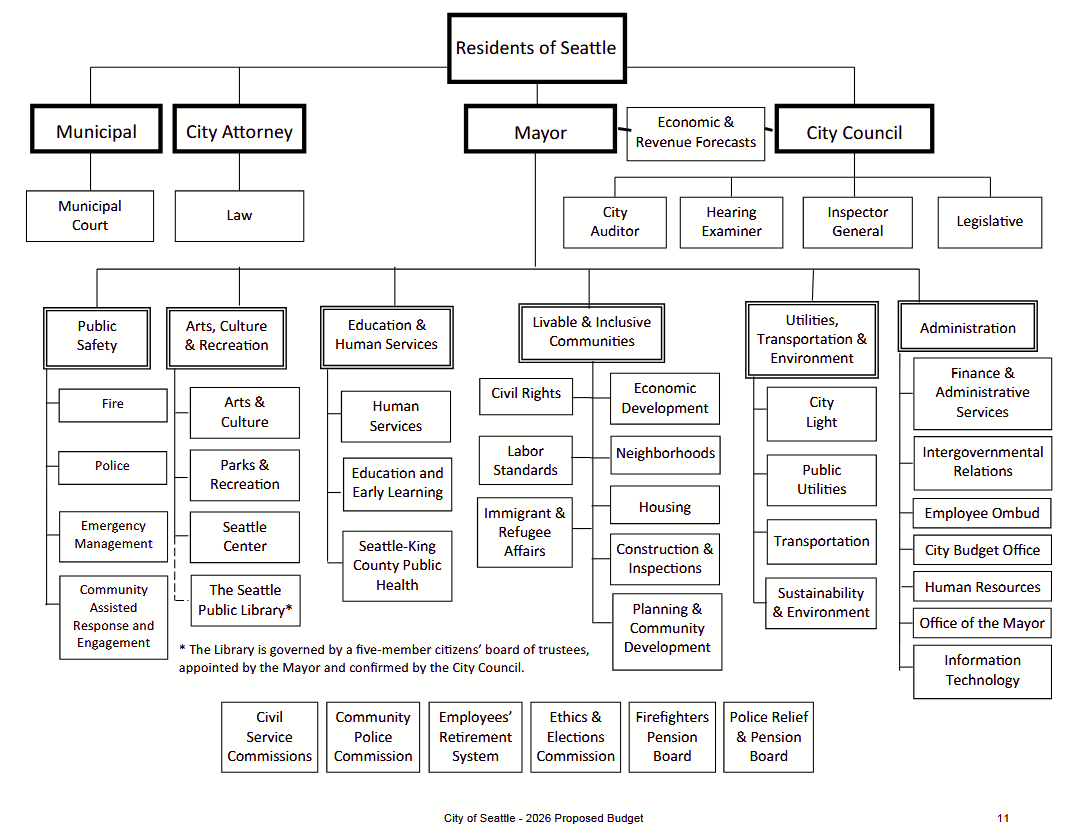
Most of the non-executive branches of The City of Seattle contain the singular department that comprises the people that work for that branch. The Legislative Branch has a few ‘offices’ nested within it that are based on officials that head up bodies of work that are appointed by the City Council, namely the City Auditor, Inspector General and the Hearing Examiner. Allow me to ignore the situation with the Office of Revenue Forecasts, for the time being.
The Executive Branch, on the other hand, has north of 25 departments and offices nested within it. The heads of these departments and offices are appointed by the Mayor (most of the time, more on that later), and can be either immediately removable by the Mayor, or have a set term limit after which the Mayor can approve of reappointment or decide to appoint someone else. The heads of these departments or offices can be “Directors”, “CEOs”, or “Superintendents” to name a few titles. Many of the department or office heads are also subject to confirmation by City Council. They are usually joined by a second-in-command that serves as a deputy, though larger departments can have multiple people sharing that tier of leadership.
Some departments and offices are direct-service, meaning that the work they are tasked with interfaces with the public of Seattle (Fire Department, Human Services Department, Parks and Recreation, etc.). Others are split up by function and have to do with administrative or support functions for The City of Seattle as an organization - such as Seattle Department of IT, Seattle Department of HR and Seattle’s Finance and Administrative Services Department.
The providence of each department and office can be very different from one another and is established by different legal mechanisms, but generally speaking the structure from this point down the hierarchy are not legally mandated outside of yearly budget allocations. Department and office leadership can determine how they will organize themselves to meet the legal requirements that do exist around staffing, labor practice and to accomplish the work they are charged with doing.
This means that you will start to see greater diversity of structure, more edge cases and a higher rate of change that means that specific information in this article could grow woefully out of date at the drop of a hat. Still, I believe it’s instructive to go over the basic model that is adopted for the sub-organization of departments and offices, and I am in the process of gathering specific information about the next ‘tier’ of organization for our departments.
For distinctions underneath the Department and Office, I will use a variety of charts produced by Seattle Department of Transportation that’s published on Yumpu, which can be found here.
Divisions
Within each department or office, the next level of distinction made is by division. These are organizational units usually headed up by a director-level position that often carries the title of “Division Director”. From here, the size of Divisions vary greatly, and there’s no apparent uniformity across the different departments and offices in The City of Seattle on how this distinction level is defined.
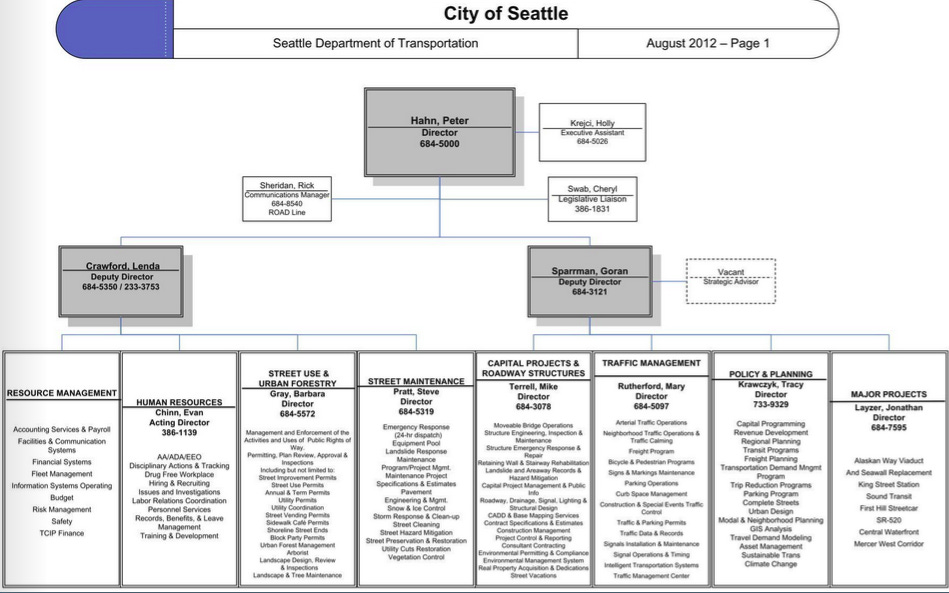
There are, however, some basic patterns that can be observed. Often times, leadership can be designated as its own division, separate from any specific body of work that is being done by the department or office. Additionally, support functions such as ‘finance’, ‘information technology’ and ‘human resources’ are often formed into their own divisions, if a department or office is large enough to benefit from this.
Mirroring the higher tier distinction, ‘service type’ or ‘subject’ is another quality that separates divisions. In Human Services Department, for example, there are Divisions dedicated to Aging & Disability Services (ADS), Youth and Family Services (YFE) and Safe and Thriving Communities (STC). These all have a division director at the head, and are in charge of broad subject areas or types of service that are conducted by Human Services Department.
Now is a good time to mention that the current slate of Departments, Offices and Divisions have not always been what they are. There are cases where divisions have been spun out in an executive restructuring into their own offices or departments, or moved from one division to another. There are also cases where an office can become a part of or change into a department. Departments and their subdivisions can and have dissolved in Seattle’s history, but it is exceedingly rare for an entire body of work being done by The City of Seattle to just stop in its tracks, meaning that this organizational shuffling at the division level is a mechanism for absorbing and distributing changes caused by top-level management decisions. This dynamic is mirrored more commonly by some of the lower-tier distinctions.
From here, the taxonomy breaks down significantly, and no longer represents necessary mutual exclusivity (though it often still does). Regions, Sites and Units or teams are much more tailored to the function of each division that houses them.
Regions
For the largest departments of The City of Seattle, and for some offices and departments that deal with different populations or areas, there is often a regional distinction made. This is usually lead by a manager, but for large departments can be a senior manager. Titles at this point break down entirely, and there’s a lot more diversity in what people of a similar title across different departments may be tasked with.
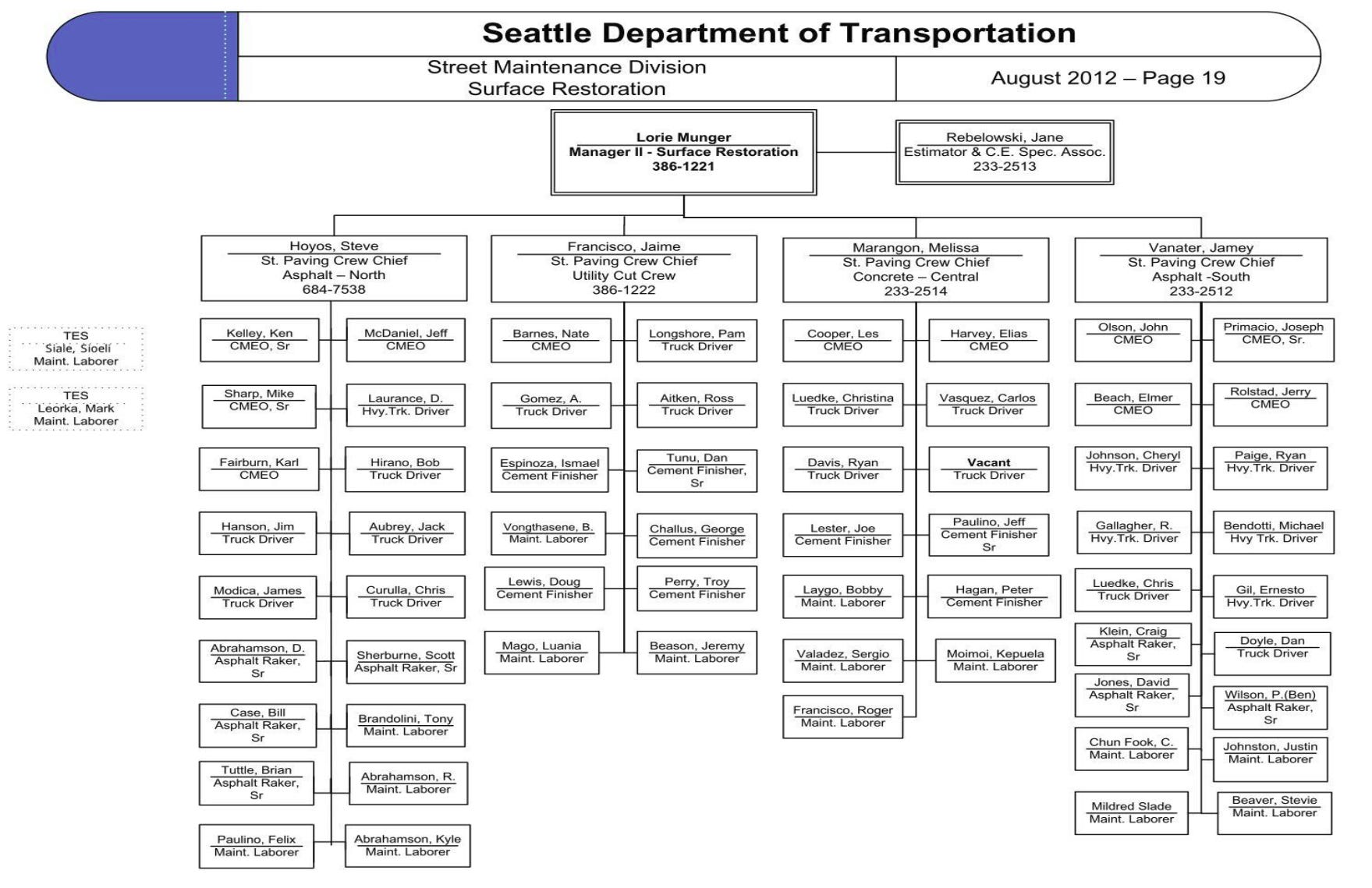
Regional distinctions can be made like having “zones” or “districts” that are unified by leadership at the region-level. Departments that do this often have fleets that require physically traveling to different regions of Seattle, but not exclusively - a good example would be in the Department of Neighborhoods, there are coordinators that are tasked with regional work that don’t have entire teams of people reporting to them.
Sites
Sites are distinctions based on the physical location of work. The City of Seattle owns and operates more than 100 buildings that are staffed with individuals that are organized by work function as well as by the physical building they are assigned to.
This is a meaningful distinction because represents a common budgetary and cultural distinction. A site can have a budget, including for staffing, that is separately defined from its region or division, and staff within the site (even if in separate divisions, which occasionally will happen) will have a sense of unity or cohesion that is important organizationally. The reporting structure mostly follows a model where there is a person in charge of the site, often at the coordinator or manager level.
Units and Teams
Below the division, and often below sites are specific units or teams. This refers to staff in an arrangement towards a specific body of work or project. The head of a unit or team can be a supervisor, manager or coordinator - there are many different titles that can lead a team or a unit.
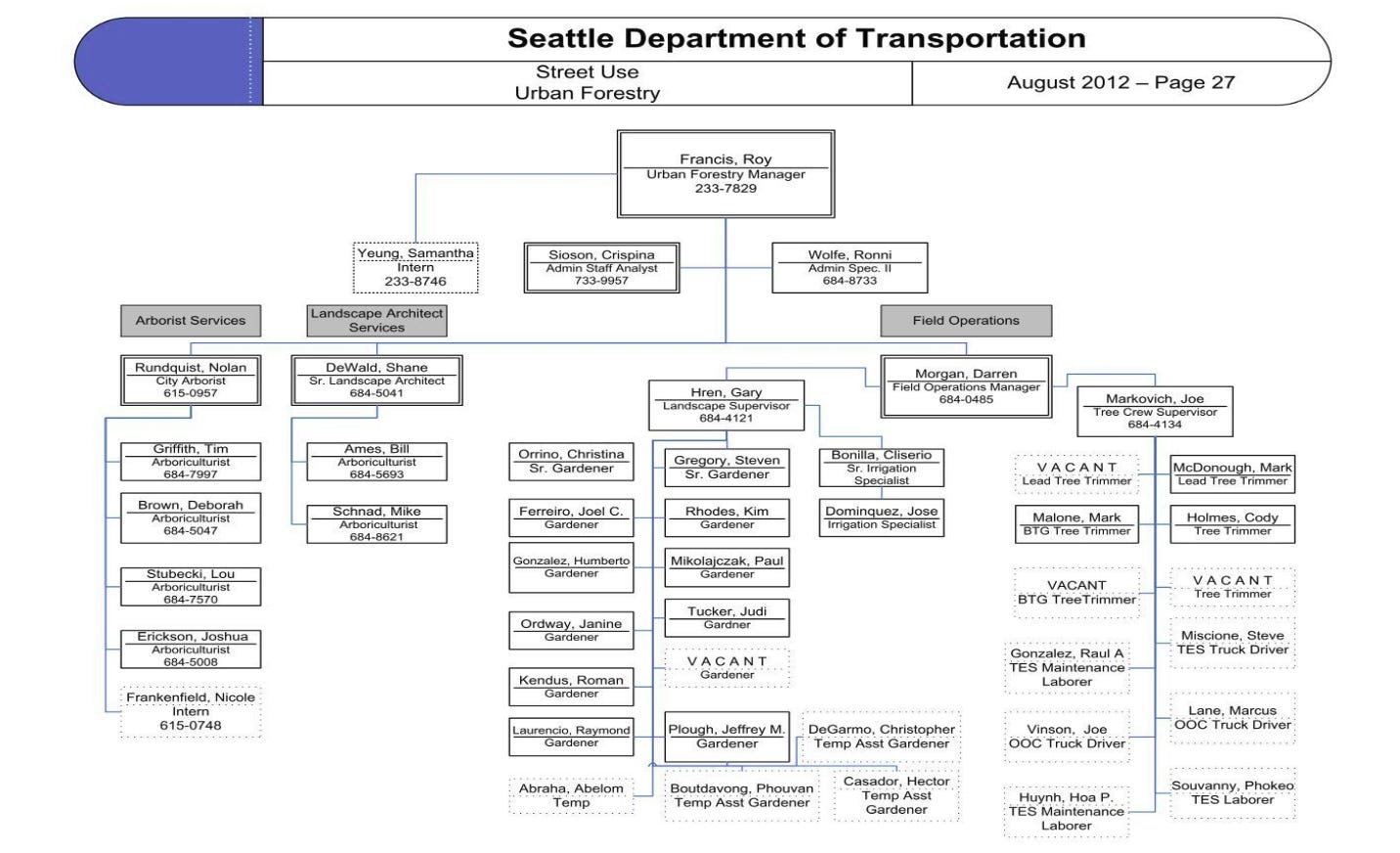
There’s often a high degree of fluidity between units or teams, with staff swapping out, staff assigned to multiple and temporary expansion or contraction happening commonly. These can be created ad-hoc, as permanent projects or fields of work, or can form out of the merging and dissolution of units throughout the department or office. The task of mapping out all of the units of The City of Seattle would be nearly impossible with the rate of change and the lack of unified reporting structure for announcing these changes outside of each department or office, but is an interesting and useful distinction for analyzing organizational dynamics.
Pockets, Roles, Classes and Titles
Below the Unit, you have pockets, Roles, Classes and Titles. These are used interchangeably sometimes to refer to the actual budgeted roles that people fill when they are hired by The City of Seattle. These may be subject to Human Resource review, but are the most fluid type of distinction in the City of Seattle, able to be established overnight by decisions made often at a far lower level than executive leadership.
Pockets evolve, change, rearrange, and are eliminated often, and from a birds-eye view, unpredictably. They are the basic unit that are used to budget out and envision staffing needs. Pockets are often “1 Pocket” = “1 FTE” (Full Time Equivalent - a full time job), but on occasion are comprised of partial FTEs, meaning that the pocket is filled by either a part time worker, or one full time worker across multiple pockets.
Individuals
This final level of distinction, dear reader, is “you” and “me”. The City of Seattle employs more than 10,000 individual people to accomplish its work. People slot into pockets, which are parts of units, that can be a part of a site that’s within a region, that is part of a division of a department or office that is within a branch of The City of Seattle.
At this level, there is infinite potential for organization. People’s attitudes and minds change every day. The way they relate to their colleagues and the system is always in flux. The degree of responsibility and power any individual feels waxes and wanes, and their engagement with the city is based on a mix of mercenary fulfillment, circumstance and a spirit of public service.
Conclusion
Teasing out the dynamics that form, reform and create changes in a system like this is the ultimate goal of “The Lanyard Board” as a project, and my personal interest in researching comparisons between The City of Seattle and other cities’ structures. Further editions of The Lanyard Board will look at some of the historical cases, edge cases, and report on data collected that clarify the different organizational dynamics and tiers of The City of Seattle.
By understanding these distinctions and tiers, I believe we can make better informed decisions about how we organize materials and resources to an efficient end. I also believe it’s important to highlight the democratic inputs and the outputs of the city I live in, such that people can participate more fluidly and receive resources that they may not be aware of. If there are any such resources or democratic inputs you care about, please reach out!
The best way to keep up with further conversations is to be a subscriber to The Lanyard Board, and to check out The Lanyard Board on social media.
The Lanyard Board is supported by readers like yourself. If you can, please support the project on Ko-Fi and tip the suggested amount of $2 for every month you feel a spark of enjoyment, insight or curiosity from The Lanyard Board.
Thanks for reading The Lanyard Board! Subscribe for free to receive new posts and support my work.