

Housekeeping
We’re coming upon a full month of these newsletters, with half of the weekly issues sent out while I’m traveling abroad. So far - so good! I have no short backlog of topics to write about, including snippets from folks I’ve met in Hokkaido and the things I have learned in Japan about disability access and local government. Asahikawa and Kitami have proven extremely interesting as examples of two very differently sized cities where I’ve met some of the civil servants (320K population vs 3K population), but in both cases I have learned a lot! (more on that later)
I’m not changing the format of having one full article that serves as a deep-ish dive into some kind of Municipal-Structure-Feature or puzzle, but I will be changing the format of the email slightly. I’ll be introducing the subject later in the body, but starting with a bit of a ‘round-up’. For this week, it’ll be links to the Instagram posts that I have made the past week detailing things done and learned in Hokkaido, but in future weeks I will likely be simultaneously posting those to The Lanyard Board’s website and Instagram, and link to TLB instead. Don’t worry - those more regular posts will not be pushed into everyone’s email inbox, but rather sit on this website for people to browse at their leisure.
Weekly Roundup
This section is a collation of links to the newest blog posts about smaller topics and daily events.
Hokkaido Day 1 - Instagram
Hokkaido Day 2 - Instagram
Hokkaido Day 3 - Instagram
New Favorite Sources
This section will provide links to sources I think are interesting for the purpose of understanding cities, Seattle and otherwise.
New Resources
This section will provide links to resources such as infographics that have been produced in the past week that are useful for understanding, mapping or working with City of Seattle stuff, broadly. Information used will only be comprised of public sources, with citations.
Current infographics will be updated onto their own pages within the next week. Next week’s newsletter will link to them.
TLB3 - Department Categories in Seattle
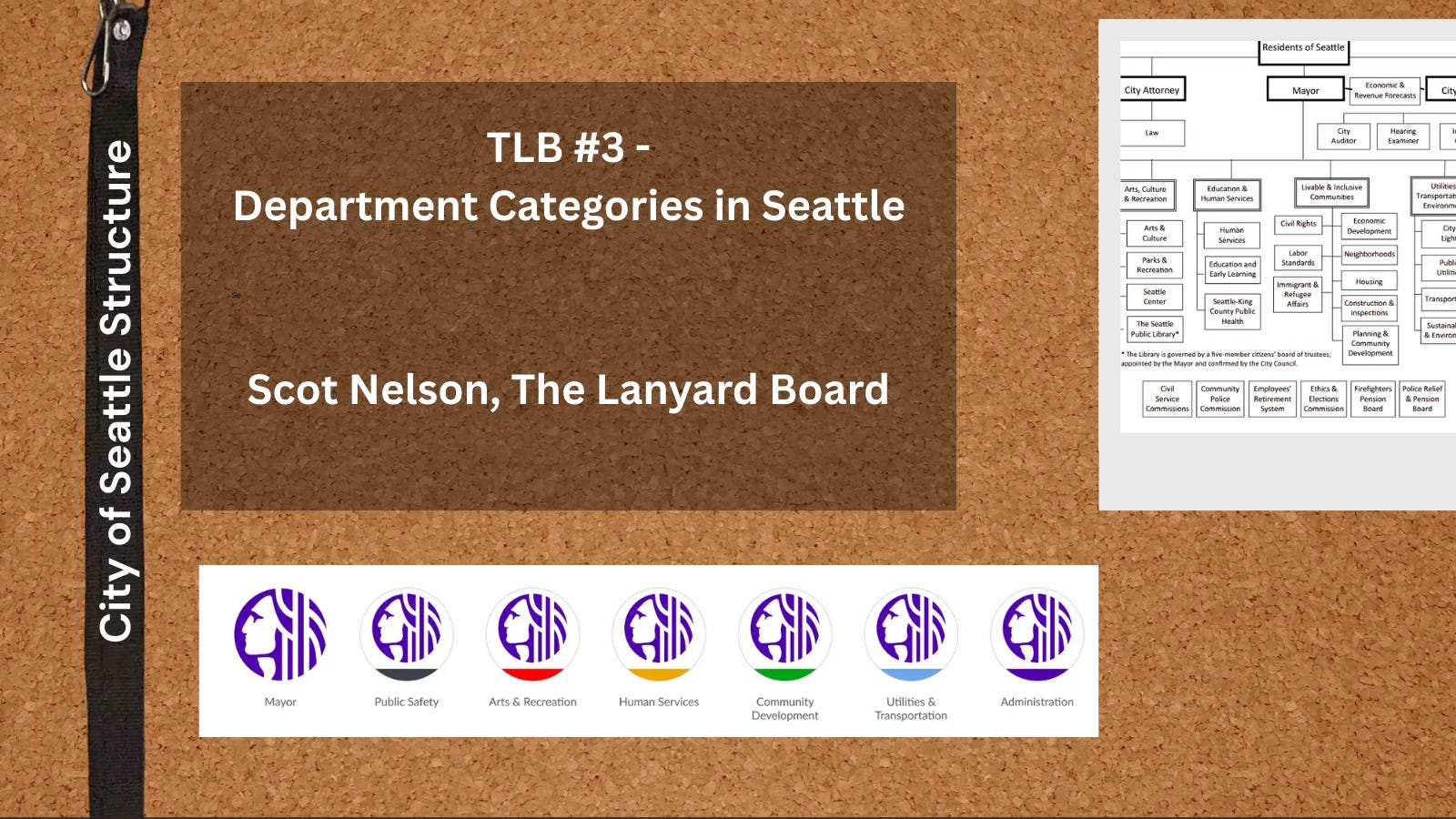
In the City of Seattle, there are definitely a lot of quirks in how Departments and Offices are organized. Typically, they are penultimate-level organizational structures that report to the Executive, Legislative, Judicial or City Attorney leadership, and are given broad, federated power to handle affairs under their purview.
Departments are not (typically) geographically restrained - meaning they can work anywhere in Seattle, and aren’t restrained to only working in one district of Seattle or another. This changes slightly when you are dealing with emergency services, and for the sake of organized workflows departments will often segment the city into zones, this is a practice rather than a requirement. Seattle lacks lower-tier government structures by ward, district or other devolved administrative bodies, so its executive work is all carried out city-wide by the central administration that is segmented into different specialties, or ‘offices and departments’.
Note: Seattle has districts - legislatively. Since the advent of Legislative Districts for Seattle’s City Council in 2013, many of the ‘lines’ that are drawn to divvy up work by departments have aligned with the council district boundaries for consistency’s sake. Over time, this could create de facto devolved administrative units, but that is not clearly established.
Because work done by the City of Seattle is not divvied up at the highest level by geography, but rather by specialty, a lot of attention is given to the broad spheres of life or civil administration that each department or office is tasked with administering.
For the sake of not getting too deep into the discourse around “what makes a department” today, I’m going to be focusing on how the City of Seattle buckets its departments listed in the recent City Budget, and using it to inform our growing model of the City of Seattle’s structure.
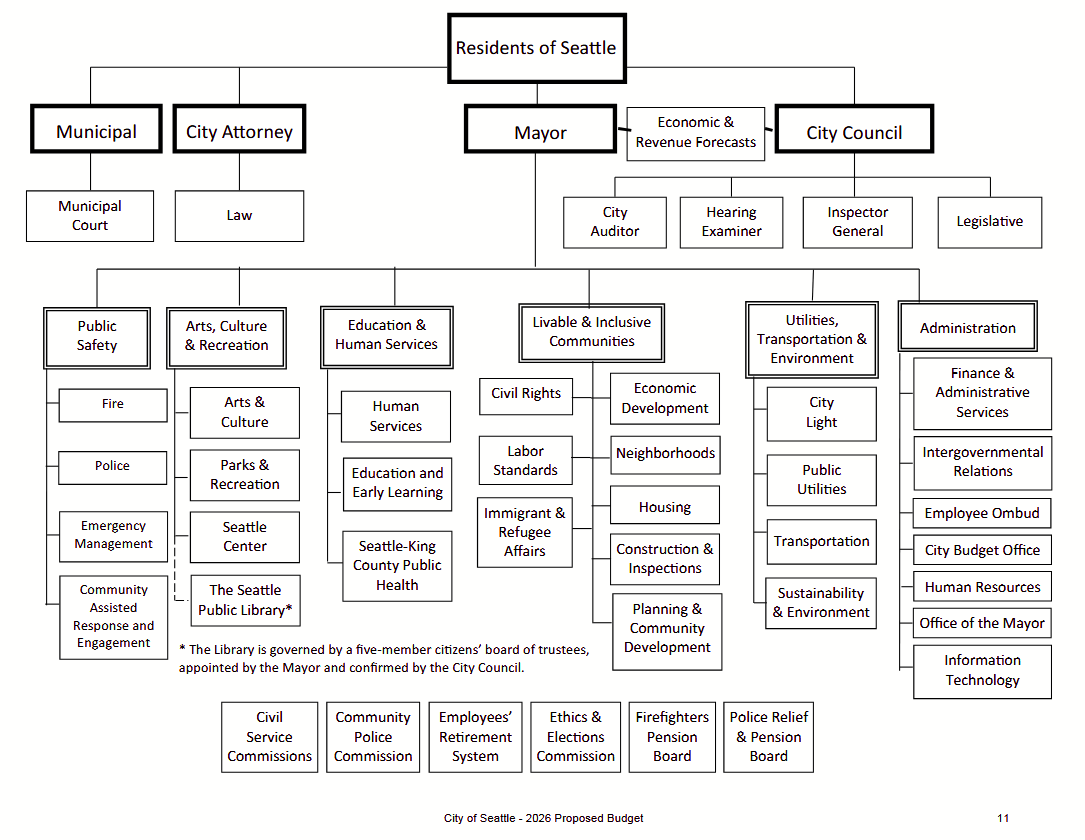
The City of Seattle, in its budget proposals and approved budgets, has adopted a practice of providing a public-facing map of departments that are being funded. Towards the bottom of figure 1, you’ll see 6 departments that are not connected to or expressly subordinate to any branch of the City of Seattle - this is likely due to these being lines of funding appropriated by the City to support 6 independent Boards and Commissions, all of which have either quasi-judicial powers or which are legally established retirement and pension instruments. We’ll take a look more in-depth at this category of office/department entity later, but for now we’re going to focus on the six different ‘lines’ of departments visible in figure 1.
Department Categories
The six categories used in documents like the Proposed City of Seattle Budget and in its Digital Style Guidelines are as follows:
Public Safety
Arts, Culture & Recreation (Arts & Recreation)
Education & Human Services (Human Services)
Livable & Inclusive Communities (Community Development)
Utilities, Transportation and Environment (Utilities & Transportation)
Administration

When we look at these buckets, we begin to see familiar groupings from when we looked at the new City of Seattle Council changes. To iterate on what we did there, we’ll be adding to our model by adding a visual indicator that a department or office belongs to one of these ‘department categories’.
Council Standing Committees vs. Executive Categories
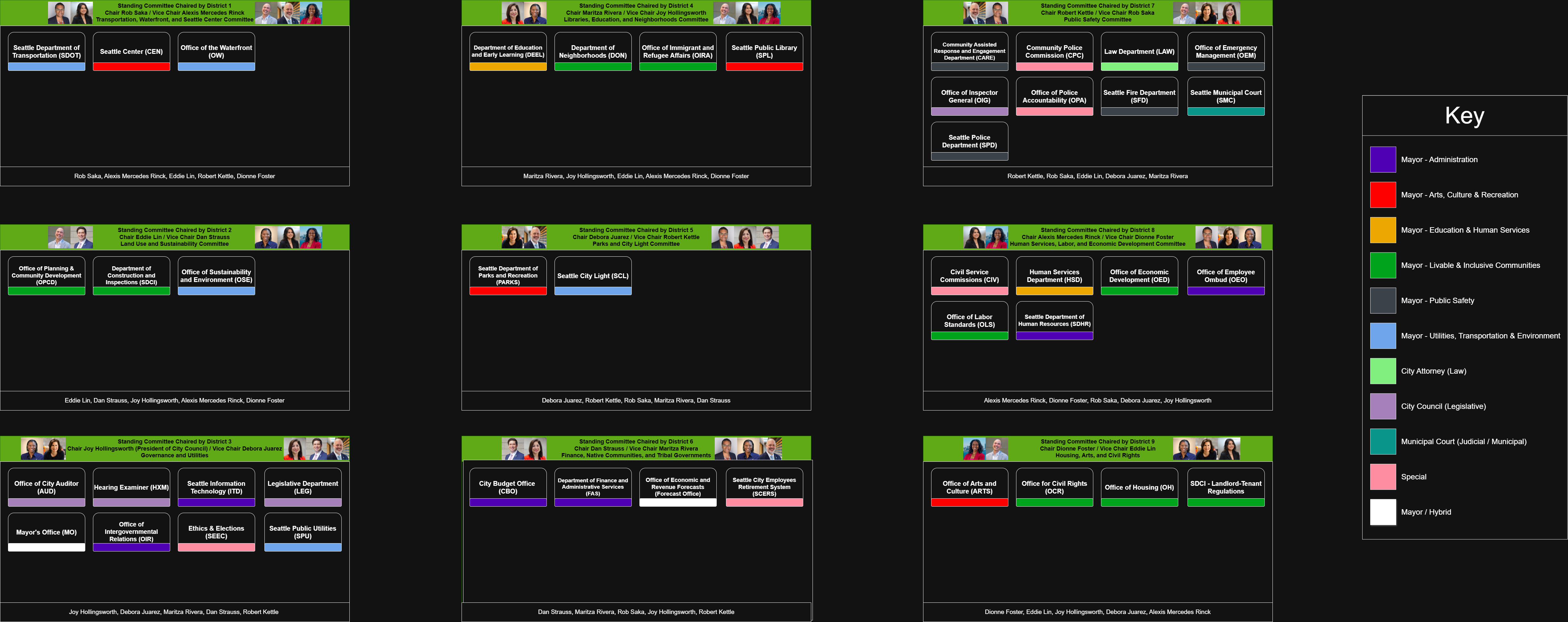
In this model, we’re looking at all departments and offices, not just those that fall under the Mayor’s Office in fig. 1. To accommodate this, I have taken the liberty of assigning arbitrary color codes not previously defined in fig. 2 to the branches outside of the executive and to the strange cases of the Commission-Departments and the Hybrid Revenue Forecast situation.
When comparing the two grouping mechanisms - Council Committee Oversight and Executive Category, we find quickly that they don’t map cleanly onto one another. All council committees oversee departments from multiple categories, and all categories - with the exception of public safety - have departments represented in multiple council buckets. There are likely many reasons for this - there could be a fundamental difference in how the executive and legislative branches see as the purpose of departments, or there could be some functional reason why categorizing departments one way in terms of how the city portrays departments to the public is different than what is required logistically for a council-member to oversee the bodies of work. After all, “Public Utilities and Transportation” covers so much uneven ground that it would be maddening to keep a comprehensive oversight over all of their operations.
One other contributing factor to the visual pattern we see is that each department or office is not fully analogous to the others. They are different sizes, serve different functions, and have somewhat different features depending on the legislation that created them. There’s a problem of comparing apples to oranges - there are many comparisons that can be made between the two, but the fundamental differences need to be grappled with.
To try to pick apart potential causes for this, I will be looking at a few factors in the coming weeks and identifying the way these bodies of work are split up not only by “department”, but when thinking about metrics such as budget, staff FTEs and revenue. This may narrow down some of the likely causes for how these different categorization schemas shake out, and lead us to a better working model for understanding the City of Seattle as a whole - and hopefully, a method for sketching things out that can be replicated across cities and systems to identify and implement better policy.
The best way to keep up with further conversations is to be a subscriber to The Lanyard Board, and to check out The Lanyard Board on social media.
The Lanyard Board is supported by readers like yourself. If you can, please support the project on Ko-Fi and tip the suggested amount of $2 for every month you feel a spark of enjoyment, insight or curiosity from The Lanyard Board.