

Housekeeping
The format will continue as it has, but because I’ve been taking time to get settled, there’s been a minor disruption. Back to normal in no time, I assure you.
Weekly Roundup
If you’re interested in travel pics and a few lines of narrative, feel free to check out the Instagram posts from this past week, but I’ll be returning to adapting them to full posts here on The Lanyard Board:
Day 1 in Haiphong
Day 2 in Haiphong
Day 3 in Haiphong
Day 4-5 in Haiphong
Day 1 in Hanoi
New Favorite Sources
Appropriately, today I’d like to highlight a couple of sources that will provide very clear lines for the comparative analysis - literally.
https://gis.vn/don-vi-hanh-chinh-viet-nam Is a gis repository/viewer that contains data for all of the boundaries of the geopolitical sub-units of Vietnam prior to the 2025 changes and after the 2025 changes. It’s invaluable for getting a sense of how things have changed, and also for me when plotting out where I’m visiting!
https://data.seattle.gov/dataset/Neighborhood-Map-Atlas-Neighborhoods/w3qt-9btr/about_data Is a gis repository/viewer that contains data for all of the Neighborhood boundaries found from the City Clerk’s atlas in the City of Seattle. This has been largely supplanted functionally by the CRAs, which is another good data source, but these two datasets combined give a great idea of how people self-recognize, and how the city recognizes, sub-municipal communities of people.
New Resources
This section will provide links to resources such as infographics that have been produced in the past week that are useful for understanding, mapping or working with City of Seattle stuff, broadly.
None are provided this time - but check back next week!
Seattle, Haiphong and Policy Mobility
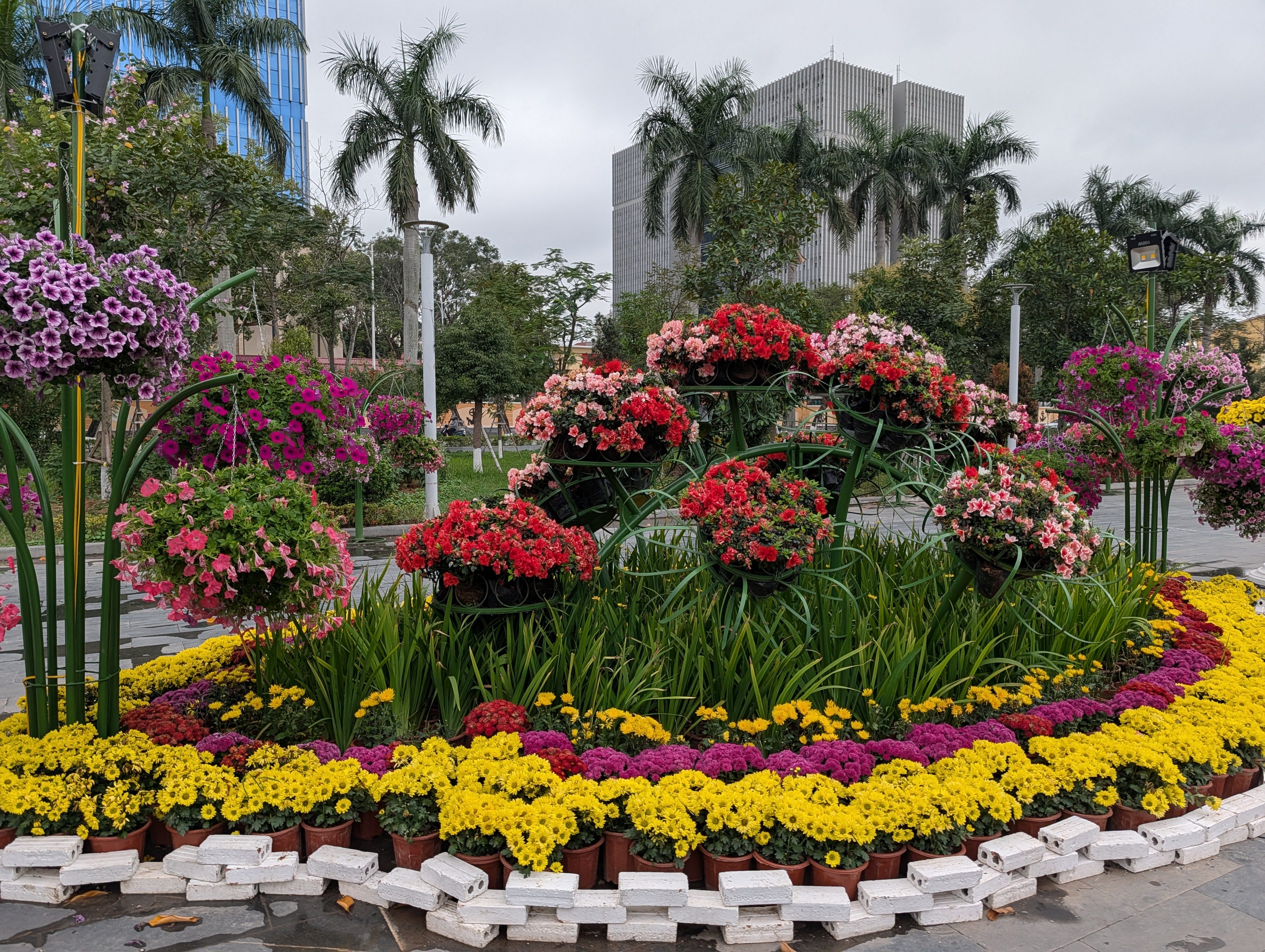
The City of Seattle is, by most standards, not a particularly large city, both on the national level and certainly on the global level. It represents, however, one of the largest and most dense urban areas in the region, being larger than its larges Northern Neighbor (Vancouver, ~660k, 143 miles) and its Southern Neighbor (Portland, ~640k, 174 miles).
In contrast, Philadelphia (~1.6m) is less than 100 miles from New York City (~8.3m), with large or mid-size cities like Baltimore and Washington DC within a few hours’ drive to the South. The East coast - and especially the mid-Atlantic region has many municipalities that inform the growth of each other, creating competing patterns of traffic infrastructure, commute, job development and homeownership that are fundamentally dissimilar to what you see out here in the sleepy Pacific Northwest.
Without large neighbors, it is a place which can takes its cues - learn from the struggles and successes of others - from anywhere. One source of inspiration I’m keen to analyze is in how its Neighbor across the Pacific Ocean in Vietnam (Read: https://www.thelanyardboard.com/p/the-lanyard-board-0-intro-to-thec) continues to develop rapidly while administering much the same resources that any city in the United States would.
Over the last few weeks, I have been getting settled in Vietnam, and have spent the lion’s share of my time in our Sister City, Haiphong. While there, I have visited around 10 of the cities 114 “phường, xã and đặc khu”, or their “wards, communes and special zones”. In this context a ward is as you might know it in the US - a sub-unit of a city that is urban with its own legislative and executive branches. Communes are the same as wards, but rural, and special zones are the same as wards but tend to be reserved for administrative anomalies such as coastlines, wetlands or islands that have their own governmental apparatus.
I have two parallel projects - one which is going ahead on behalf of the Greater Seattle Vietnam Association, and one which is tied to my Graduate studies but is in a grey-zone-limbo until I have connected with the government of Haiphong on some specifics. The latter is the Comparative Analysis I’ve written about before, but the former is a social media project to personally visit and do something fun in all 114 of the phường, xã and đặc khu. Ideally, part of what I will be learning during my time in Haiphong and over the next few months are how the workload is split between the central city municipal government and the ward governments, and how processes are handled centrally or diffused.
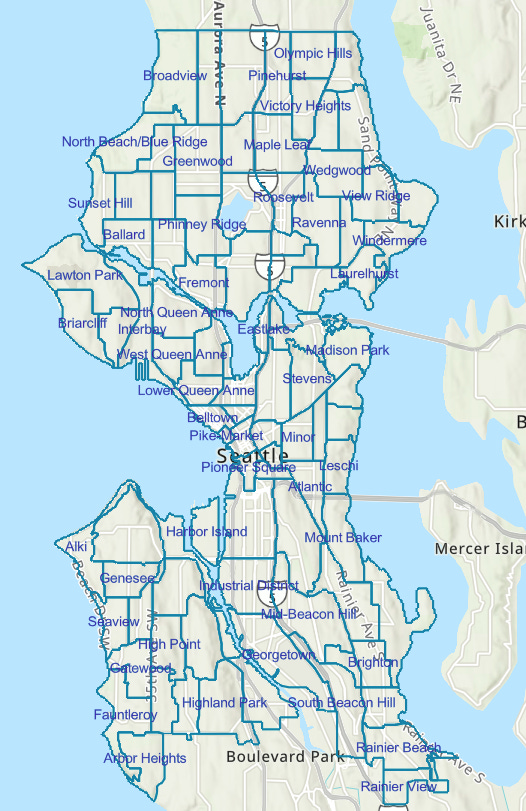
In the City of Seattle, we have a lot of analogues that sort of gel into an amalgam that has similarities to a formal ward structure. We have districts - legislative districts. We have planning and design zones. We have police and fire precincts. We have community centers, pools and their zones. We have Neighborhoods (Community Reporting Areas), and we have Libraries. There are lots of lines in the sand that designate certain administrative centers of mass for the City of Seattle to administer services and resources. There are strategies that are taken by department staff such as Department of Neighborhood staff to create greater cross-departmental cohesion within the neighborhoods that people live in, and there’s an invisible pressure that’s placed on all City action within a Legislative District that is at the very least considered whenever programs are being administered from that District.
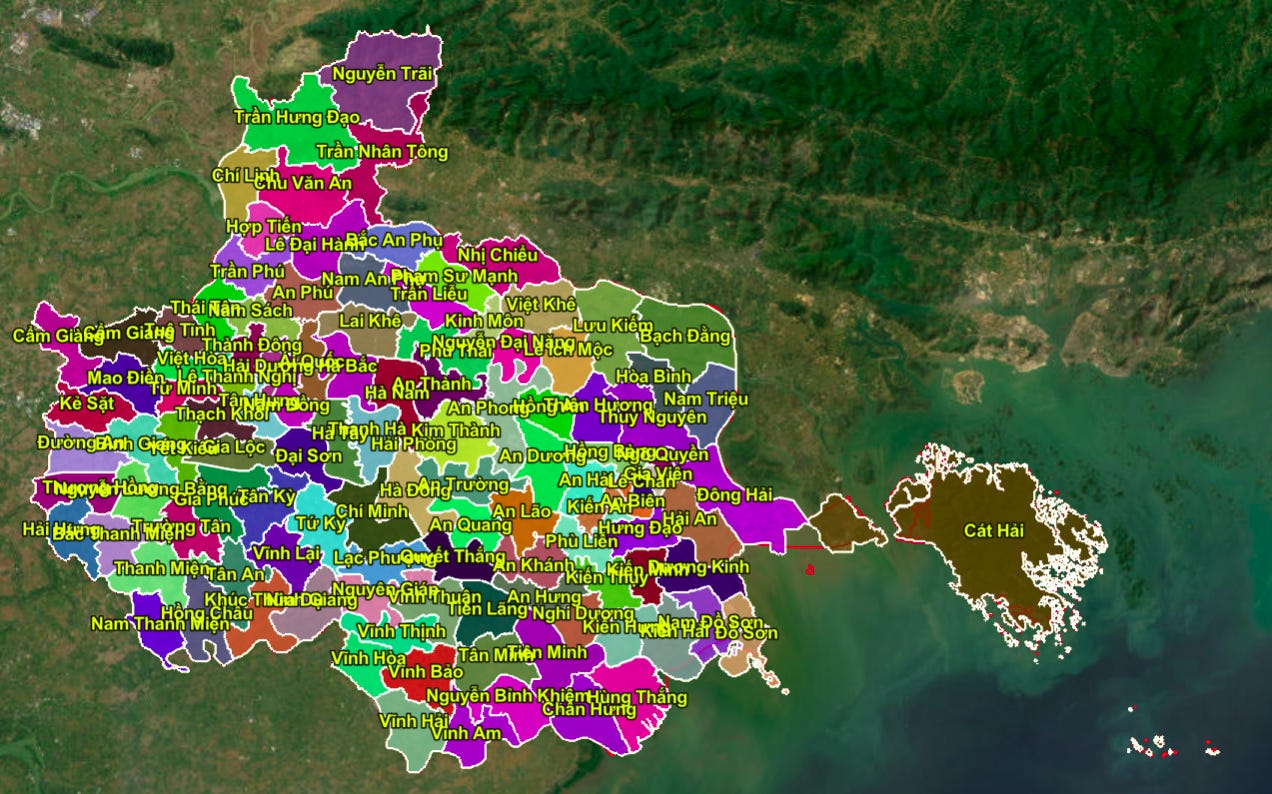
Knowing how to answer the question “Is it better for services to be administered from the top down, as opposed to localized organs closer to the grass roots?” is not something I’m going to be capable of. What I hope to tease out, through both research and this project to visit the whole of our Sister City, is where both strategies shine and have strong impact.
Policy Mobility is the phenomenon by which a set of policies is adopted outside of the place that those policies originated. It happens all the time, everywhere. This is blindingly obvious but painfully under-remarked; Nobody wants to reinvent the wheel. But rather than designing the wheel from first principles, or taking a design that works given specific road infrastructure somewhere else, I think Seattle has the unique ability to imagine a better world and work towards it through learning principles of design and organization that can originate from anywhere.
Seattle ❤ Haiphong
Which brings me to the heart-emoji of this week’s issue. Over the next few months, I will continue visiting the various phường, xã and đặc khu of Haiphong with an aim towards spotlighting the fun and the interesting while also getting a feel for the city itself. It has been amazing to see Haiphong so far, and I can see why it was chosen as Seattle’s Sister City in Vietnam - the port city “vibe” is immaculate.
In each of these areas, I’ll be taking a photo (like below) where I am holding a whiteboard that states Seattle’s ❤of the ward/commune/special zone I’m in, and Seattle’s overall ❤ of Haiphong. Think about it like visiting all of the Neighborhoods of the City of Seattle and taking a similar picture (Seattle ❤ Beacon Hill, Seattle ❤.... Seattle?).
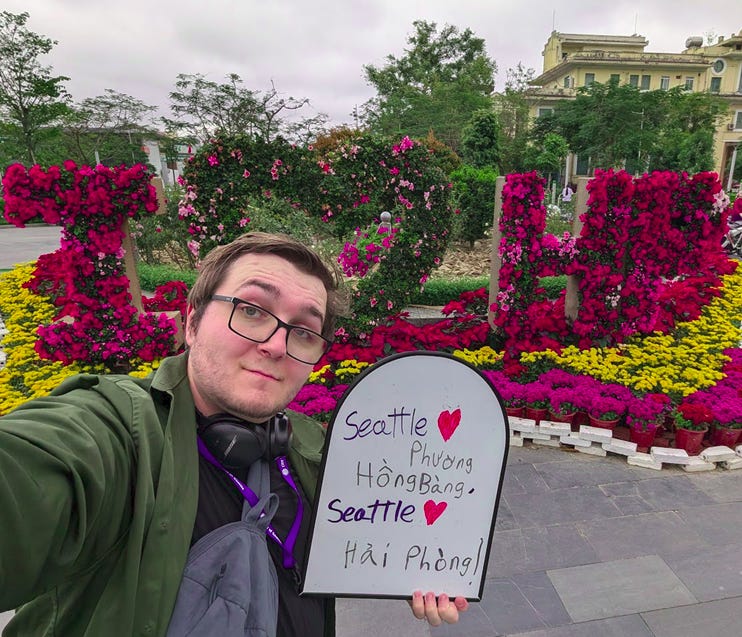
I’ll be posting these, and a brief reflection on what I’ve learned about the ward/commune/special zone from official sources on the GSVA Facebook: https://www.facebook.com/GSVA2017 Please be patient with me, as once I start, I’ll likely keep it up as a daily ritual, so I’m trying to space out when I know I’ll have the photographs and posts ready.
Final Notes
Haiphong has been great to me so far and I continue to look forward to seeing more of it. Please feel free to reach out to me at Scot.Nelson@Thelanyardboard.com if you have any questions or would like to chat - it gets a bit lonely abroad, yeah?
The best way to keep up with further conversations is to be a subscriber to The Lanyard Board, and to check out The Lanyard Board on social media.
The Lanyard Board is supported by readers like yourself. If you can, please support the project on Ko-Fi and tip the suggested amount of $2 for every month you feel a spark of enjoyment, insight or curiosity from The Lanyard Board.
Thanks for reading The Lanyard Board! Subscribe for free to receive new posts and support my work.