

Cities of the World
Cities, no matter where you are in the world, have similar administrative functions and goals. Transportation Infrastructure, Planning and Development, Healthcare, Education, and Utilities like Water, Sewage and Power are universal needs for dense urban areas. City governments are often the “closest governments to the people”, representing the unit of government that most directly communicates and distributes resources to residents and citizens of a jurisdiction. Because city governments need to meet emergent needs, and communicate so closely with the people whose needs they need to meet, their functions and forms are influenced not only from the “top-down” (Economic systems, legal formalities, higher-tier governments), but from the “bottom-up” (geographic, cultural, infrastructural, epidemiological needs that emerge locally).
If you were to take any two dense urban areas at random, the convergent design is obvious. We identify them, naturally as “Cities”. We recognize roads, buildings, institutions, and somewhere in there, a cohesive unit that gives us a sense of parity that lets us talk about the places we visit, live and work. This parity extends across nation-states, cultures and economic systems, giving us a common language for forming relationships. For the rest of this article - and for the next two years - I will be talking about two cities that have different sociopolitical and economic systems, yet have striking commonalities in challenges they face.
Seattle and Haiphong - Sister Cities
Seattle has a 30-year relationship with its Sister City in Vietnam, Haiphong. The Greater Seattle Vietnam Association has been an advocate for a strong and healthy relationship between the peoples of Seattle and Vietnam more broadly since its inception in the 1990s, and it acts as the conduit for the relationship between Seattle and Haiphong. Seattle and Haiphong have been sister cities since September 30, 1996. This bond formed following normalization of US-Vietnam relations, a visit from the mayor of Haiphong to Seattle in 1995 and the work conducted by the Greater Seattle Vietnam Association since its inception in 1993. Through this bond, the GSVA has contributed resources to orphanages, clinics, schools, libraries and other civic organs in Vietnam and Haiphong over the course of these 30 years.
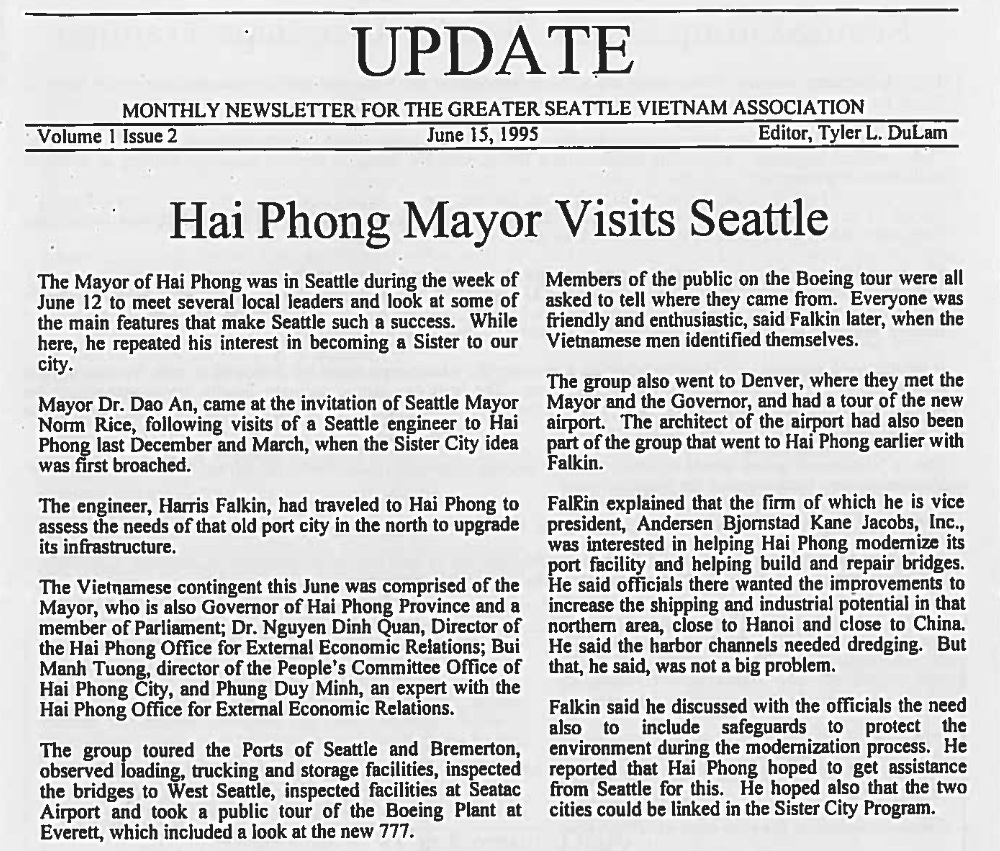
Haiphong, then, is chosen as a research subject as a City which has direct ties to Seattle that Seattle may learn from and contribute to. The concerns of Haiphong as a port city which has rapidly expanded over the past few decades are similar to the concerns of Seattle as a port city that is facing projected expansion over the decades to come. This research is intended to identify strategies and distributions of administrative resource that help Haiphong and Seattle be exemplars of environmental stewardship and prosperity in their regions. My hope as a researcher is to uncover patterns that can be identified and applied across the Pacific Ocean to the enrichment of both Seattle and Haiphong.
The Comparative Analysis Project
Despite having vastly different governance systems, functions like transportation infrastructure, utility administration and human services need to be carried out by both the cities of Seattle, United States of America and Haiphong, Vietnam - with separate city governments and municipal structures for meeting those similar goals. This project hopes to map out the organizational structure, legislative composition, and major historical developments of these two cities to uncover convergent and divergent structures that possibly impact core municipal functions. In addition, it will look at and scope out an analysis of lower-tier municipal structures (such as wards) and examine this same niche in Seattle’s context (which lacks the same type lower-tier governmental structures).
Part one of the research will be a breakdown of Haiphong's municipal structure as it is bucketed out into departments (Các sở ban ngành) of the City, mapped out down to the level of Public Service Units, if possible. Part one will also look at the organizational structure of the wards, communes and special zones of Haiphong (n=114) down to the ward-department level. A similar approach has been taken and is being taken currently to map out the City of Seattle, with its ~40 departments and office-level entities (more on the ambiguity later) and 71 active Boards and Commissions. I will analyze the distribution of administrative resources (public budget, personnel, department structure) and the degrees of separation between units of the municipal system across Seattle and Haiphong, with special attention paid to areas of overlapping mission (departments tasked with fundamentally the same function such as Fire, Power, or Planning). The main framework for understanding these agencies, units, and actors will be through the CAS (Complex Adaptive Systems) framework, which has a rich body of scholarship in public governance on describing systems through networks of agents through Complex Systems Theory.

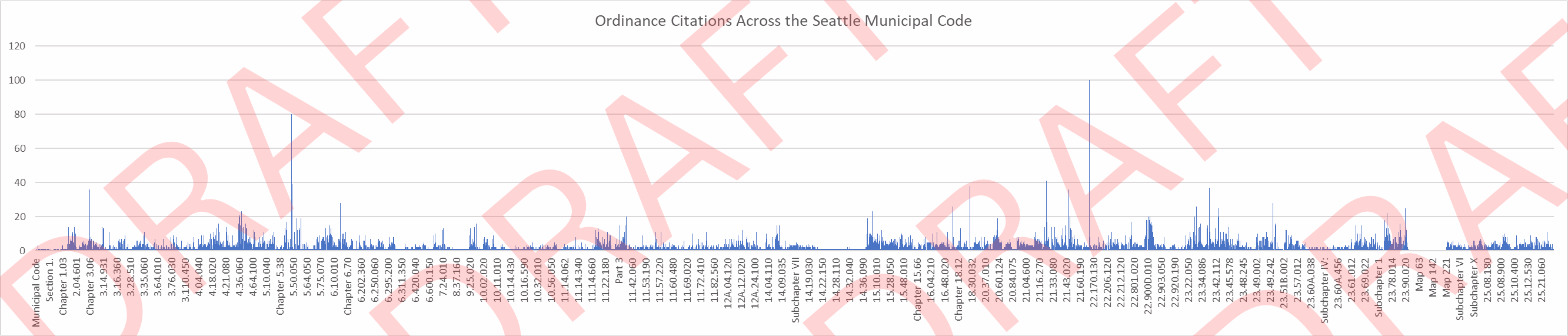
Part two of the research will take a look at the legislative composition of the two comparison subjects. In the US context, there will be minimal attention paid to the State and Federal levels, instead focusing in on the power that the City has to amend its Municipal Code through Ordinance. The composition of the Seattle Municipal Code, and the rate at which parts of the Code change or undergo policy mutations have been tracked through the ordinance citation system across the Municipal Code. I will be performing a similar analysis of the Resolutions and Decisions of the City and Ward Level People's Councils and People's Committees in Haiphong for the rates of old law being overturned by new law, in the absence of a "municipal code". Rates of change across certain topics of municipal law will be compared and placed along a timeline for understanding which topics are more heavily prone to new legislation in both cities at different points. Evolutionary Governance Theory (EGT) will be an important framework here to understand policy mutations, their dynamics and potential launch points for further analysis. Like Complex Adaptive Systems, this framework takes leads from interdisciplinary analytical modes and discusses political and governance systems as reproducing systems that have a greater or lesser rate of self-propagation based on mutable factors that carry forward in its propagation.
Part three of the research will take a look at a few major historical events which change the structure of these municipalities and place them in time against one another. For Seattle, many of these have coincided with an entire rewrite or revision of its Charter, and so Seattle's Charter, its revisions and its Amendments will be looked at to see how Seattle molded into the structure it is today. Similarly, major restructuring moments (including the recent restructuring of local governments to the two-tier model in Vietnam - more on this later) will be considered for Haiphong, with some structural arrangements or patterns teased out based on the nature of the massive changes. The framework applied, and the literature consulted will largely be through PET, or Punctuated Equilibrium Theory which looks at governance structures as being less incrementally changing, and more prone to massive changes with periods of relative stability between them. PET is complementary to understanding municipal governments through an evolutionary lens, explaining how major destabilizing events create periods of rapid evolution and periods of relative stability.

Part four of the research will take a look at potentially the most major structural difference between the City of Seattle and the City of Haiphong. Seattle, as a city, lacks any Ward-level governmental apparatuses. It has legislative districts that have council members elected from them, but no district-level apparatus for the administration of the City of Seattle. Haiphong, on the other hand, has 114 units underneath the City of Haiphong, each of which have their own Legislative and Executive leadership, as well as administrative departments, party infrastructure, and Vietnam Fatherland Front apparatuses. Despite this, there are many functions that need to take place at the community-level in both Seattle and Haiphong - mechanisms for service delivery, democratic inputs and local planning are examples of functions that still need to take place at this level. I analyze those functions that are done by Ward-level governments in Haiphong in the context of the decentralized, rhizomatic network of 501 nonprofits, community councils, advisory councils, Boards and Commissions, and other non-governmental and governmental sources of community/district level civil organization. To accomplish this, I have the 53 population-tracked Community Reporting Areas of Seattle to compare to Haiphong's 114 wards and ask questions about which civic functions are present within both, and which agencies are responsible for their administration. I will synthesize some of the other frameworks consulted in my approach to propose an interaction model for both cities in comparison to one another.
Research Methods
The majority of the Research is done through the application of theoretical frameworks to public information about the structure of these local governments, laws which govern their formation and structural documents that spell out how these city governments are carved into departments, divisions and units.
In addition to this, archives are consulted from English and in Vietnamese language sources that identify the historical state of city government structures, administrative terms and major restructuring events. Scans of archival material consulted will be made available on The Lanyard Board, as well as materials such as maps, charts or other derivations of this material.
Finally, a series of interviews are being conducted to understand historical context, identify potential major restructuring events and improve the “translation” between the two cities’ analogous institutions and functions. Many Seattle-based public servants have already been consulted and interviewed for context orientation, representing officials from across all of Seattle’s Branches of government and many of its Boards, Commissions, Offices and Departments. Full interviews will be, on occasion, published in The Lanyard Board for transparency and public interest, especially when the topic of the interview is helpful for advancing the state of the art of Public Administration between the two cities - or if it is interesting.
I will be traveling to Hanoi, Vietnam for my graduate program through IPSL at Westminster University starting in early March 2026 for an 8-week program of service learning in conjunction with a local NGO while I conduct the Comparative Analysis Study. During my time in Vietnam, I will make many trips to Haiphong, Vietnam to see up-close what systems are being described, and I am mapping out interviews in both Haiphong and in Hanoi to better my understanding of local governance and effective public administration. Anecdotes and excerpts of my research will be continually published in a weekly newsletter format here in The Lanyard Board directly sent to subscribers at no cost. I will also regularly be posting updates about the project and full explorations of Seattle’s municipal systems (including resource links, datasets, maps and other resources).
The final research product will be submitted to journals for peer review with a prospective timeline of 2028, with more details being revealed as time goes on.
Best Ways to Learn More
The best way to keep up to date would be to subscribe to The Lanyard Board. Expect weekly editions to be sent via email, but more regular updates will be kept on the website, rather than overloading your inbox.
You can also find The Lanyard Board on many social media platforms, as well as connect with me on most popular messaging apps. Click the button to reach me anywhere and anyhow you please.
Finally, funding for the comparative analysis project is independently secured, with no major funders or grants. Funding for the Graduate Program was secured through the Segal Award for AmeriCorps Service along with personal savings. Interviews, research material and consultations have been provided generously by subjects without compensation.
The Lanyard Board is (and will remain) free-of-charge and independent. For that to be a reality, I'm holding out the hat! Please consider a tip on Ko-Fi to help support me and my half-of-a-rent I still need to pay in Seattle while I’m abroad. The suggested tip if you enjoy The Lanyard Board (or feel affinity or sympathy for me) is $2 per month you enjoy. I certainly wouldn't turn my nose up at more - or turn away less, so please 'pay-what-you-can'. Your support is greatly appreciated!