

Housekeeping
This week, it’s mostly about Haiphong! After having learned more about the restructuring of local government, I’m ready to share a ‘primer’ on what major changes our Sister City has gone through. It’s a bit shorter than usual - but next week I’ll make up for it by including some sweet, sweet diagrams.
Weekly Roundup
If you’re interested in travel pics and a few lines of narrative, feel free to check out the Instagram posts on the Instagram. I am working to get these uploaded to The Lanyard Board site (Still. It’s… just so much work, you know?). If you cannot access the Instagram, follow request for access!
https://www.instagram.com/thelanyardboard/
New Favorite Sources
https://thuvienphapluat.vn/en/index.aspx - Third party repository for different types of legal documents issued by the Vietnamese Government, with English translations for important business-related laws.
New Resources
This section will provide links to resources such as infographics that have been produced in the past week that are useful for understanding, mapping or working with City of Seattle stuff, broadly.
None this week - check back later for some diagrams being published on the form of local government in Vietnam!
Introduction to Org Structure: Haiphong, Part I
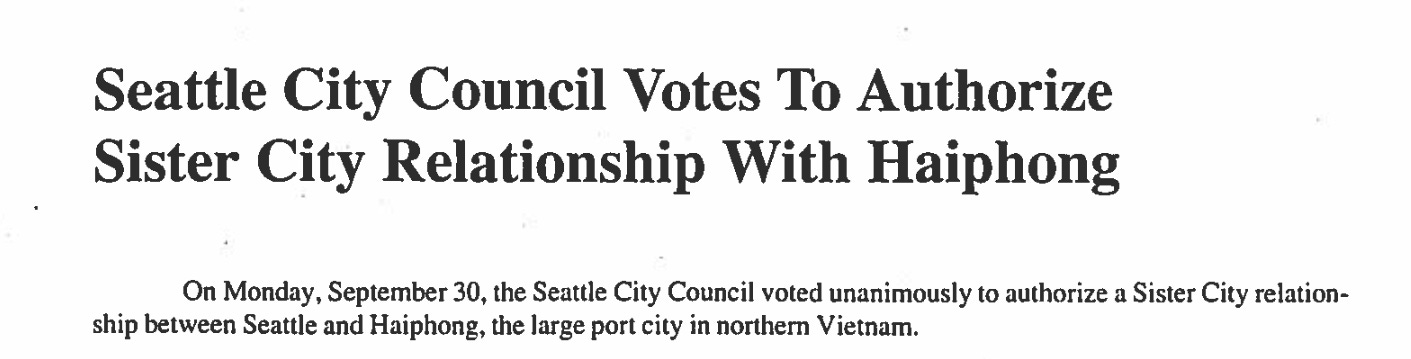
Seattle and Haiphong have enjoyed their Sister City status for 30 years starting this year, having formed in 1996. Haiphong in 1996, however, is a very different place from what it is in 2026, both in terms of the massive development and expansion of the middle class that Vietnam as a whole has seen over the past three decades, and due to a major series of reforms of the local government in Vietnam that went into effect in July of 2025.
Mergers All Around
One element of this change is that the number of “Province”-level governments were cut down from 63 to 34, with the land mass and population of provinces (and the largest cities of Vietnam, which share the same “level” of government as a province) were merged. This change, for Haiphong, meant the merging of the nearby province of Hai Duong into Haiphong - meaning that Haiphong effectively gained ~1,668.28 Square Kilometers of land and ~2,196,095 people.
One way to think about this, from the context of Seattle, is if King County became Seattle - with the government of the City of Seattle absorbing the tax base, voting base and administrative responsibilities of the additional land and individuals that became a part of it.
The actual law that spells out the rearrangement is DECISION NO. 759/QD-TTG from April of 2025 ON APPROVAL OF THE SCHEME ON REARRANGEMENT OF ADMINISTRATIVE DIVISIONS AT ALL LEVELS AND DEVELOPMENT OF THE TWO-TIER LOCAL GOVERNMENT MODEL.
That is a mouth-full, but the actual legal component that deals with Haiphong reads as follows:
“Merge Hai Duong province and Hai Phong city into a new centrally-affiliated city named Hai Phong, with the administrative-political center located in Thuy Nguyen city, current Hai Phong city (reducing by 01 province), with a natural area of 3,194.7 km² and a population of 4,102,700.“
This effectively doubles the size, population and land-area-wise of Seattle’s Sister City in Vietnam, and is all the more reason to undertake this process of getting to know them as they exist now.
From Three Tiers to Two Tiers
The other major element in the restructuring is the removal of district-level governments. In the past, Haiphong (and indeed, all centrally governed Cities and Provinces) had three tiers of local government. Next week, I will be releasing Part 2 of this look at Haiphong’s local government structure, and in it, I will produce some diagrams that help spell out the accurate general structure of both the 3-tier and 2-tier government models.
For the time being, just know that Vietnam, prior to 2025, operated with a 3-tier local government model that included “province level”, “district level” and “commune level”. In the restructuring, Vietnam now operates on a 2-tier local government model that only includes “province level” and “commune level”.
To imagine this from the Seattle context (sorry King County for using you again as an example), but this would be as if all “Counties” in Washington were dissolved, and all you had left were the “State” level governments and the “City” level governments. In such a rearrangement, as with what happened in Vietnam, you’ll get some of the functions of the ‘middle’ level that was dissolved being evolved up to the higher tier, and some being devolved down to the lower tier.
The prior law cited is what establishes the top-tier of government of Haiphong as a City which is now comprised of its old boundaries + those of Hai Duong. The law which establishes the new boundaries of the lower-tier (commune tier, made up of ‘wards’, ‘communes’ and ‘special zones’) is RESOLUTION NO. 1669/NQ-UBTVQH15 from June of 2025 ON ARRANGEMENT OF COMMUNE-LEVEL ADMINISTRATIVE DIVISIONS OF HAI PHONG CITY IN 2025.
Front-to-back, this resolution goes through each of the new commune-level units (n=114) for the newly constituted Haiphong, and gives the legal description of the required boundaries for these new units relative to the prior configuration.

What This Means
Haiphong is considerably larger in area and population than before. (Roughly Doubled, now sitting at a natural area of 3,194.7 km² and a population of 4,102,700.)
Functions (including economic development, licensing functions) have been transferred from the depreciated “District” level government to the City and to the Communes/Wards/Special Zones.
There has been a massive shuffling of public servants around different levels, offices and an overall massive reduction in the total size of the bureaucracy.
Haiphong has had about a halving of administrative units in total, having had more than 200 “Commune-level” units prior to the administrative reform.
Next Steps
The next steps for this project include the furthering of context-building conversations with the City of Haiphong itself, and ascertaining the redistribution of municipal functions that occurred during the restructuring. The end result of clarifying this could be useful information for The City of Seattle in how it can more deftly interact with the City of Haiphong, as well as be useful for anyone who has an interest in understanding the business and development environment Haiphong now inhabits.
As I continue to visit all of the commune-level units within Haiphong, I hope to gain a further appreciation for the entire shape of the city in its current form. You can find photos and write-ups of these little visits on the Greater Seattle Vietnam Association Facebook page!
The best way to keep up with further conversations is to be a subscriber to The Lanyard Board, and to check out The Lanyard Board on social media.
The Lanyard Board is supported by readers like yourself. If you can, please support the project on Ko-Fi and tip the suggested amount of $2 for every month you feel a spark of enjoyment, insight or curiosity from The Lanyard Board.
Thanks for reading The Lanyard Board! Subscribe for free to receive new posts and support my work.