

Housekeeping
The format remains the same from last week. There may be some interruption in the next week, but I will make a special announcement if-so. This coming issue is almost entirely a blend of slice-of-life and qualitative data gathering on events in Hokkaido, Japan, so be sure to check back in future weeks for the regular fare of numbers and charts.
Weekly Roundup
This section is a collation of links to the newest blog posts about smaller topics and daily events.

Hokkaido Day 12

Day 12 in Hokkaido is over! I went and took a cursory look at the Sapporo Snow Festival, which is incredible - it is absolutely massive, both in scope of the festival and the number of people who were there to enjoy the festival.
Hokkaido Day 13

The end of Day 13 in Hokkaido, and the end of the second day of the Sapporo Snow festival. Finally got around to visiting all 11 blocks of Odori Park and seeing what exhibits and sculptures there were. A few of the blocks had massive snow-sculptures that were multiple stories tall, and the 11th block (which normally has park decorations celebrating inte…
Hokkaido Day 14

Day 14 - two whole weeks - in Hokkaido have come to an end. Today was probably the most relaxed day so far, despite being a travel day - made our way to Otaru from Sapporo, and stopped by Chitose to check out the @cfm_miku_official Miku Sky Museum for Snow Miku. It was a lot of fun to check out this exciting and wonderful part of the culture of winter f…
Hokkaido Day 15

End of Day 15 in Hokkaido, Japan. Woke up and spent the whole day in Otaru, which is in the far West of Hokkaido, past Sapporo. What makes it special this time of year is that there’s a Hatsune Miku (Vocaloid) special exhibit that celebrates Hokkaido through a yearly “Snow Miku” that is based around a central theme that often showcases specific industri…
Hokkaido Day 16

Day 16 of Hokkaido - the last full day. Tomorrow I move by way of Shinkansen down to Tokyo where I’ll be staying in Shinjuku for the rest of the week. I cannot imagine a better end to my time in Hokkaido - Asahikawa.
Hokkaido Day 17

Today, Day 17 in Hokkaido - I have to say goodbye for the time being. I traveled south from Asahikawa all the way to Shin Hakodate where I took the Shinkansen (bullet train) to Tokyo. It felt bittersweet to leave, given all of the wonderful memories I have made over the past few weeks, but I am glad to have experienced so much in such a short period of …
New Favorite Sources
This section will provide links to sources I think are interesting for the purpose of understanding cities, Seattle and otherwise.
None are provided this time - but check back next week!
New Resources
This section will provide links to resources such as infographics that have been produced in the past week that are useful for understanding, mapping or working with City of Seattle stuff, broadly.
None are provided this time - but check back next week!
Weekly Story - Event Overview, Tokachigawa SAIRINKA festival, Hokkaido, Japan
When thinking about the events hosted in the City of Seattle, a few will come to mind for those who chronically seek out fun, food and festivity - Events such as The Bite of Seattle, Big Day of Play, Seafair, Bumbershoot and the Capitol Hill Block Party draw sometimes tens of thousands of people from both the local area and from abroad to visit and spend their time and resources on coming together with bits and pieces of Seattle’s locality
Part of the goal of my travels has been to take what I’m learning about event-running here in the sometimes-harsh environments of Hokkaido back to Seattle, and I think the event I’ll be talking about today is illustrative of a kind of ingenuity that imbues events like these with local character.
In Tokachi, the region known as a sort of Bread Basket of Hokkaido, there are a few festivals that take place within arm’s reach of Obihiro - one of which I have already written more thoroughly about in last week’s piece about the Lake Shikaribetsu ice village. This week, we’re going to take a look at an event that takes place just to the Southeast of Lake Shikaribetsu in Otofuke - a winter festival dubbed “SAIRINKA”.
SAIRINKA is a blended event - it feels in some parts like a rave, with a set and lights set out within geometric shapes across a snowy white hill that change colors to the beat of the music. Along with this were elements that I’ve seen in other festival locations such as snow-rafts being pulled by snowmobiles, tunnels of light and a warm food hall that helps keep the balance for families feeling a bit too frosty.
Maybe appropriately for this blended style of event is the music set - a mix of current trends and oldies, and even a mix of American English songs and Japanese songs. I nearly lost my gourd when Katy Perry’s Fight Song started playing alongside the pulsating lit objects. From the observation deck, people watched the light show on high, but there were a great number of children and families out amongst the lights dancing and having a fantastic time.
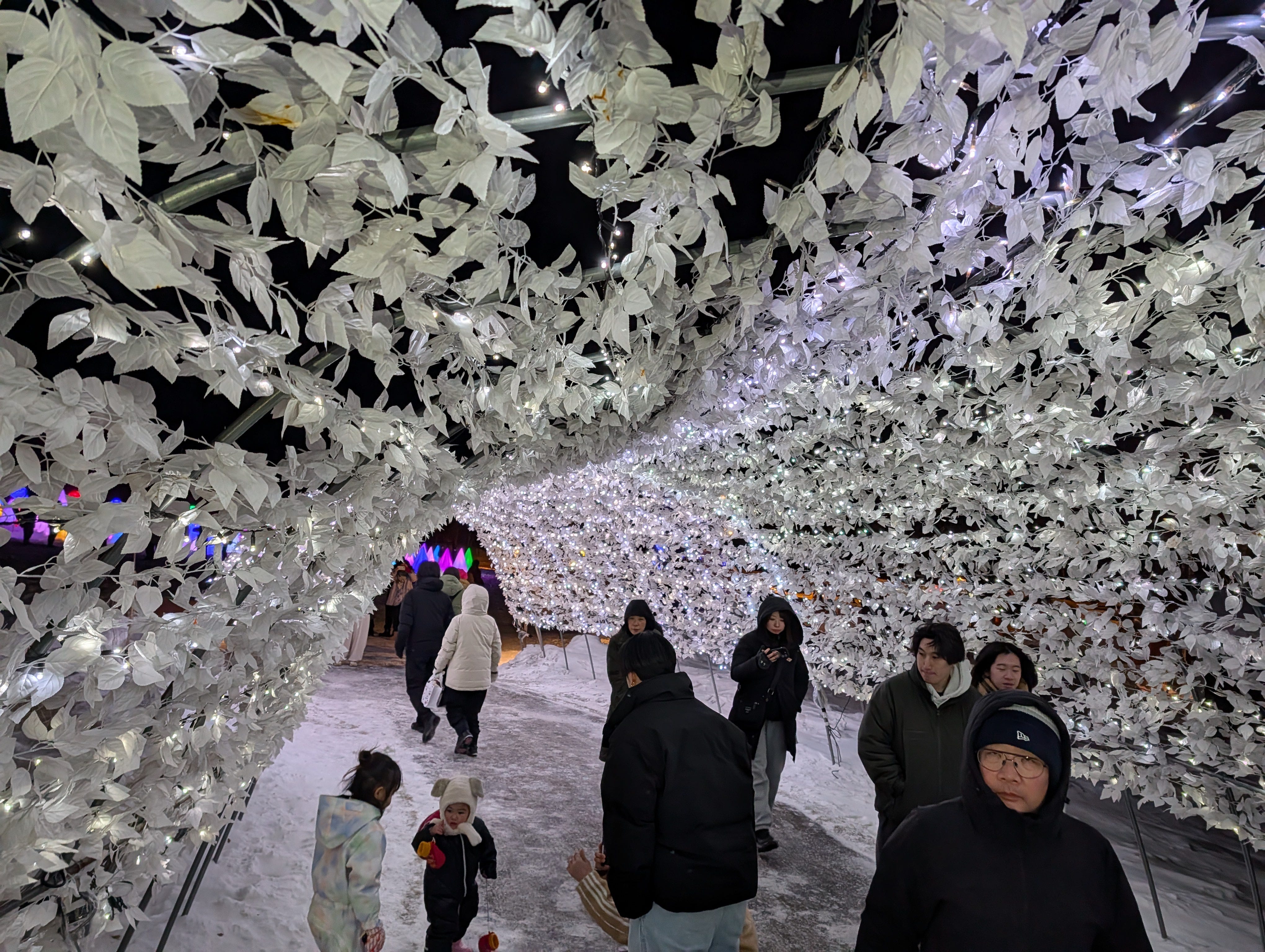
I got the chance to speak to one of the organizers of the event to learn more about how the event came about and how it’s enjoyed each year. Starting 35 years ago, this event now pulls nearly 50,000 people during the month-long period of the event. There have been a lot of iterations of the event, and there’s been a lot of trial and error as to how exactly the event goes, but the current state of it is sustainable, meaningful and beneficial to the local economy.
Sustainability
The region SAIRINKA takes place in is the Tokachigawa Onsen, on the outskirts of Otofuke. The weather patterns in the dead of winter are different from many parts of Hokkaido, even slightly further south in Obihiro. As opposed to being below freezing all of the time, it gets extremely cold at night and gets enough direct sunlight during the day that temperatures in some areas rise above the freezing temperature. This prevents residents and onsens of Tokachigawa from holding the type of winter festival that relies on structures or sculptures made of ice and snow.
Instead, Tokachigawa makes use of objects lit up by LED. When I say objects, I’m more-or-less directly translating the way the event organizers talk about them - over the years, they have looked different at different times, but the current sustainable iteration is somewhat tetrahedral, with some LEDs propped up on poles scattered throughout the object field. These objects are made using agricultural canvas, which is a specialty of the region due to the heavy agriculture industry, which provides a use for this canvas outside of the growing season and imbues SAIRINKA with a character that honors and celebrates the work of the region’s agricultural workers during the harsh Winters.
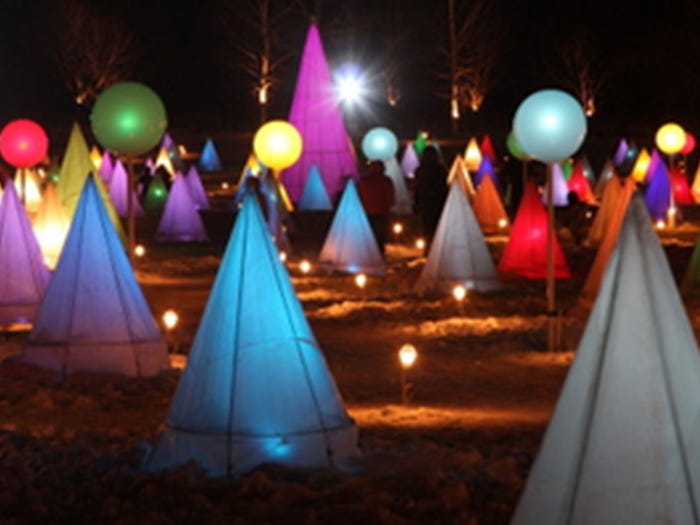
This, paired with both the reusable nature of the LEDs (as opposed to Fireworks) and the use of the natural features of the park’s snowy white canvas makes the event very sustainable, and reduces environmental impact. There’s a double meaning here when considering what is being celebrated by the event, and how the organizers understand their goals and vision.
Meaning
SAIRINKA is, in its stated aims, a celebration of the more than 1,000 swans that migrate to the region each Winter. Like in broadly Western culture, swans are seen as elegant and graceful animals that are delightful and calming to witness, and naturally take a place in the overall tourism strategy for Tokachigawa. The overall festival itself that SAIRINKA is considered a component of is called the “Hakucho Matsuri” (Swan Festival), and throughout the day (as opposed to this night-time event), there are smaller venues where one can watch Swans flying overhead to overwinter.
A common theme of the Winter festivals in Hokkaido is beauty amidst harsh conditions, and SAIRINKA does a great job of putting this on display. There is a raft ride pulled by a snowmobile that whips the rider around the outskirts of a dark, silent forest to one side, and the bright, concert-like atmosphere of the field of lit objects. In this is both a respect for, and a refusal to submit to the forces of nature. The way SAIRINKA makes this argument is through a subtle beauty that is not as grand as towering pillars or sculptures of ice and snow, but instead is graceful and quiet, spreading warmth throughout your body.
Economic Development
The last thing the organizer of the event talked about with me was the main drive behind why people felt the need for an event in the first place. Onsen, or hot springs, arise from the natural hotspring waters of the volcanic mountains throughout Japan. In Eastern Hokkaido, far from the bustling metropolis of Sapporo (pop. >2,000,000), there are many small onsen towns that help to supplement local economic regions during non-growing or harvesting seasons. Tokachigawa is one such onsen town, boasting a rare type of hotspring water which is plant-derived, called a moor hotspring (which is said to be very good for moisturizing!).
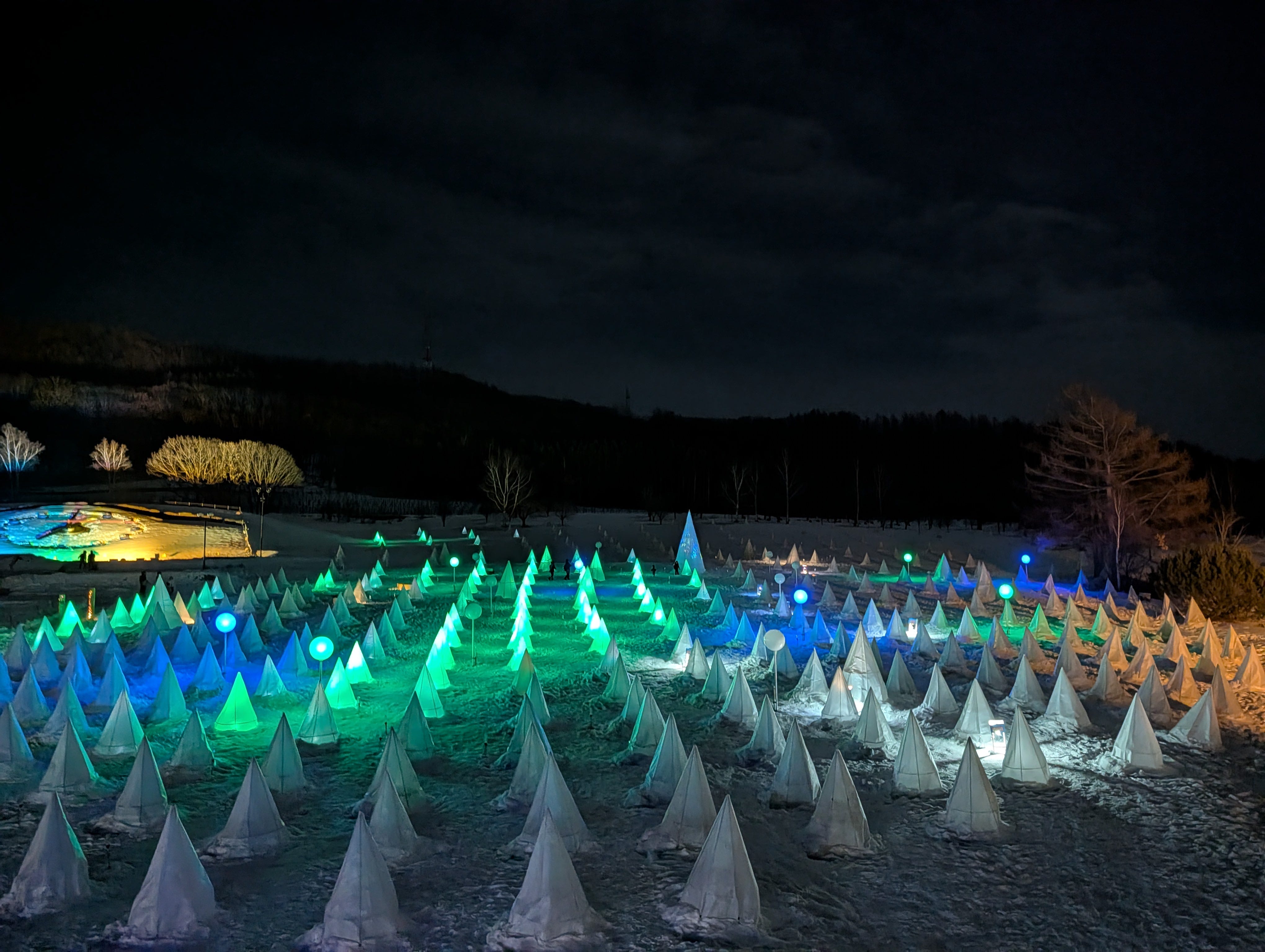
Hot springs during the winter are in a tricky place. On one hand, travelers who arrive have a place to warm themselves thoroughly, and it can be a major draw, especially locally. On the other hand, hot springs are limited by how people can actually get there - and to travel to Eastern Hokkaido in the dead of winter one has to pass through a mountain range through sub-zero, sometimes dangerous conditions. No matter how good it feels to feel both the cold air and hot water at the same time, it is difficult to convince travelers who could contribute to the local economy to make the trip east when they could stay at an easier-to-access Western Hokkaido onsen. Like we saw at lake Shikaribetsu, onsen and festivals are great complements to one another in that they drive both local and distant demand for regional economic activity.
The event organizer told me that SAIRINKA started in part to address this problem. Onsen were having to close during the winter-time because they weren’t able to sustain their staff, which has a knock-on effect for the whole regional economy. 34 Years ago, in 1992, the event started small, as a way to publicize and spread awareness of the onsen, swan migrations and other attractions, but over the years has successfully created an engine for bringing people both from abroad and from other parts of Japan to see the lights, nature and enjoy the onsen. Come for the festivities - stay for the people, the warm waters and the splendor of the Tokachi Plains.
The best way to keep up with further conversations is to be a subscriber to The Lanyard Board, and to check out The Lanyard Board on social media.
The Lanyard Board is supported by readers like yourself. If you can, please support the project on Ko-Fi and tip the suggested amount of $2 for every month you feel a spark of enjoyment, insight or curiosity from The Lanyard Board.
Thanks for reading The Lanyard Board! Subscribe for free to receive new posts and support my work.