

Housekeeping
Back from Hiatus, and ready to go with a new article. Along with an increase in the cadence of these articles, I’m changing the format a little bit from feedback.
Having resources in a “one-stop-shop” style (as in, the “resources” pages) has been popular, so I’ll be building out and posting more soon.
I’m also giving a lot of thought to the structure of these serialized articles. They are going to be heavily editorial, rambly, and good faith (but not guaranteed to be accurate, so please verify any claims directly or use the linked sources).
For accessibility purposes, I’m going to break up subsequent articles into segments based on the accessibility of the language and concepts used. I’m going to try to put accessible materials and resources into their own pages for handy reference. In the future, though, I will try to do a better job of balancing the necessarily-complex and the accessible, plain language elements.
Weekly Roundup
If you’re interested in travel pics and a few lines of narrative, feel free to check out the Instagram. It’s no longer follow-only, and is public, so please drop a follow if you like what you see.
https://www.instagram.com/thelanyardboard/
A bit late to call it a “weekly” update, but I’ve been happily employed with the City in a new department. I have settled enough that I am confident I can provide the updates and content you all deserve without running the risk of a conflict of interest. If I anticipate any subjects being professionally relevant in any conflict-of-interest-style way, I will plainly state so!
New Favorite Sources
Link to City Budget Office Website
The City Budget Office is one of Seattle’s Offices and Departments nested underneath the Executive Branch. Its website hosts the City Budget going back to 2001, making it an excellent source of the ‘narrative’ to go with the ‘numbers’ you find on the City of Seattle Open Budget Portal.
Link to City Budget Glossary of Terms
It’s no secret that I’m a big fan of accessibility. Having a glossary of terms makes it easier to both explain and share budget concepts.
Disclaimer
I am a hobbyist and a researcher studying the structure of the City of Seattle, especially as it compares with its Sister City in Vietnam, Haiphong. None of the following is meant to represent financial, legal or any other type of advice. I will avoid interpretation where I can, and will be drawing closely from the primary sources. At the same time, matters like the City Budget have historically been inaccessible due to heavy use of jargon, so wherever a plain-language summary is provided, it is done in good faith to increase the accessibility of the information to an audience of non-experts and non-nerds. If you have any concerns, or spot any inaccuracies, please email me at Scot.Nelson@Thelanyardboard.com.
Introduction to the Budget
The best introduction to the Budget is going to ultimately be straight from the City Budget Office itself. The full context provided for how the City Budgeting process works can be found as a part of the 2027-2028 proposed budget package, and the specific document can be found here:
2027-2028 Proposed Budget Introduction PDF
This document outlines the way the budget is drafted, amended, approved and modified later in its cycle.
Key facts about the City Budget:
Seattle Budgets with a modified two-year process
First year and second year are budgeted and proposed by the Mayor’s Office at the same time
First year is adopted, second ‘endorsed’ by City Council
Second year there are new opportunities to amend
There are two ‘budgets’ - operating (what we will focus on, the budget related to every day expenditures) and the Capital Improvements Program, which is for larger capital projects like infrastructure spending
Departments often collaborate and contribute to inter-departmental projects. City Council also has its own way of grouping departments under oversight committees, that is separate from the ‘functional groupings’ the budget uses (such as grouping departments by category, or the granular program and budget summary level categories). Staffing levels, leadership style and morale are some example of “invisible” influences that the budget will not be able to anticipate that will impact how offices and departments function.
What these mean in combination is that the budget can’t tell us everything about the way functions are bucketed or carried out, only how the offices and departments are given resources to carry them out. The offices and departments are themselves defined by a less coherent combination of actors, incentives, events and structures.
We won’t be talking much (this time) about revenue sources that fund the budget, as they represent a subject that deserves its own space. Instead, the budget will be used as a document that informs and structures how departments are defined.
2026 Budget Process Flyer for 2027-2028 Proposed Budget
If you are interested in learning more about the current Budget Cycle, how to get involved, and important dates, the City Budget Office has published a two-page flyer here:
Link to the Budget Process Flyer
2026 Reader’s Guide for 2027-2028 Proposed Budget
Before I go further, it would be good to link the Reader’s Guide to the City of Seattle Budget - if you are looking for specific figures and want to do research into a department or project, this guide will teach you how to quickly sort through the information presented in the budget:
Link to the Reader's Guide
Department Budget Documents
In the process of creating the Proposed Budget, the Mayor’s Office asks its offices and departments to submit their proposals for staffing changes and other Operating Budget changes. In the final budget document, the budget is arranged in order of these departments, within the functional categories that we discussed in TLB #3, all those moons ago.
For the 2027-2028 budget documents, the basic top-level format is as follows:
Department Overview
Budget Snapshot
Budget Overview
Incremental Budget Changes
Expenditure Overview
Budget Summary by Fund
Revenue Overview
Appropriations by Budget Summary Level and Program
The below are some of the high level points of data that can be extracted from each of these ‘department budget sections’. Again, I should point to the disclaimer: The goal here is to gather useful data from these source documents to understand functional associations, rather than to provide any value judgments or financial analysis.
Find the office and department budget documents for the 2027-2028 proposed budget here:
Link to Table of Contents Page for 2027-2028 Proposed City of Seattle Budget
Department Overview
Department Overview provides the narrative overview of what functions each City of Seattle office or department performs. Some features of this overview may (but don’t always) include:
Mission and/or Vision Statement
Reference to Boards or Commissions Supported by Office / Department
Race and Social Justice goals or inputs
Key partnerships (e.g. naming Seattle Public Schools)
Linking to Resources
These serve as good touch-points for how offices and departments define themselves publicly and to the Mayor’s Office year-on-year, so have important historical value as much as contemporary value to understanding how Seattle’s functional buckets work.

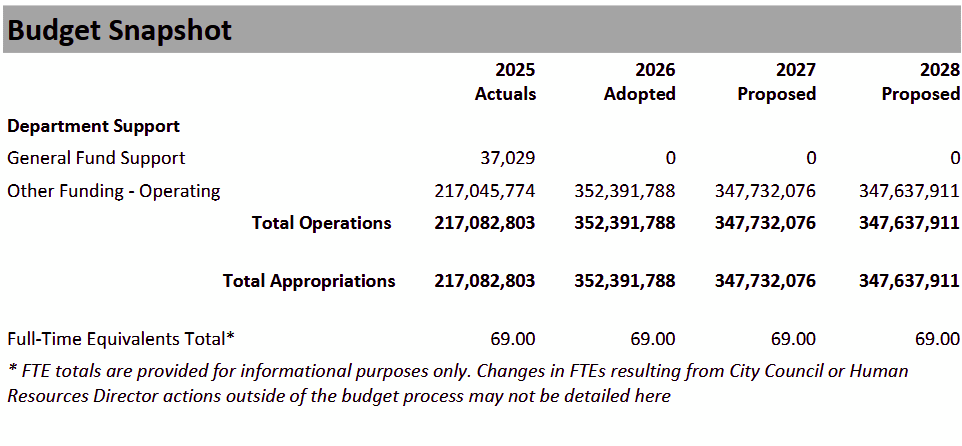
Budget Snapshot
This is the highest level overview of the budget for a given office or department. For the 2027-2028 proposed budget, it provides the following dollar figures in both the “General Fund” and “All others” categories;
2025 Actual Budget
2026 Approved Budget
2027 Proposed Budget
2028 Proposed Budget
If relevant, this snapshot also includes the snapshot figure along the same categories for Capital Support funds, but because not all offices and departments have Capital projects, this will only be present in some of the department budgets.
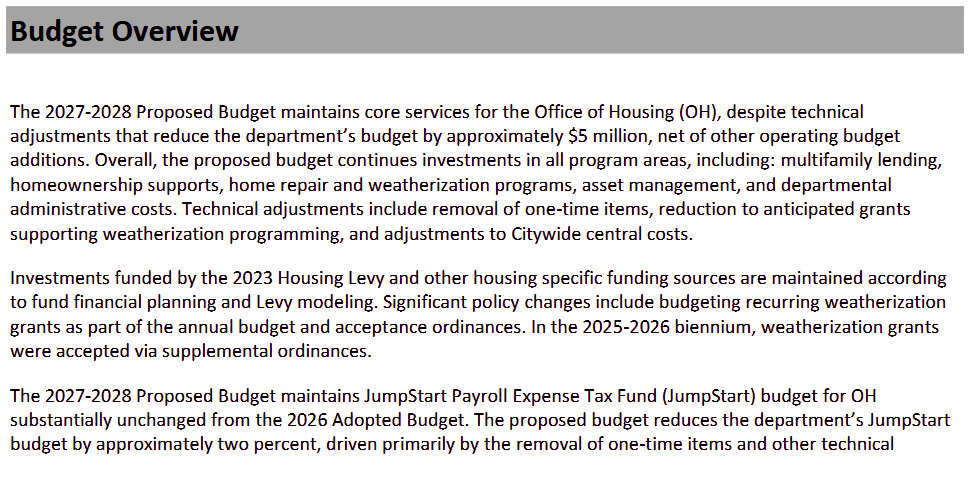
Budget Overview
This is the narrative overview of each of the changes a given office or department is making in the proposed budget when compared to past years, as well as more general narrative on how funds are spent within the office or department’s different operational categories.
Some features of this overview may (but don’t always) include:
Mention of initiatives and budgetary priorities, and how they align with Mayoral priorities
Smaller sections that provide overviews of bodies of work, including granular projects taken on by an office or department
Mention of historical significance of funding changes
Rationale and justification for reductions to workforce
This overview section is helpful for understanding the context of the budget proposal in the year that it was proposed and by what mayor it was proposed by.
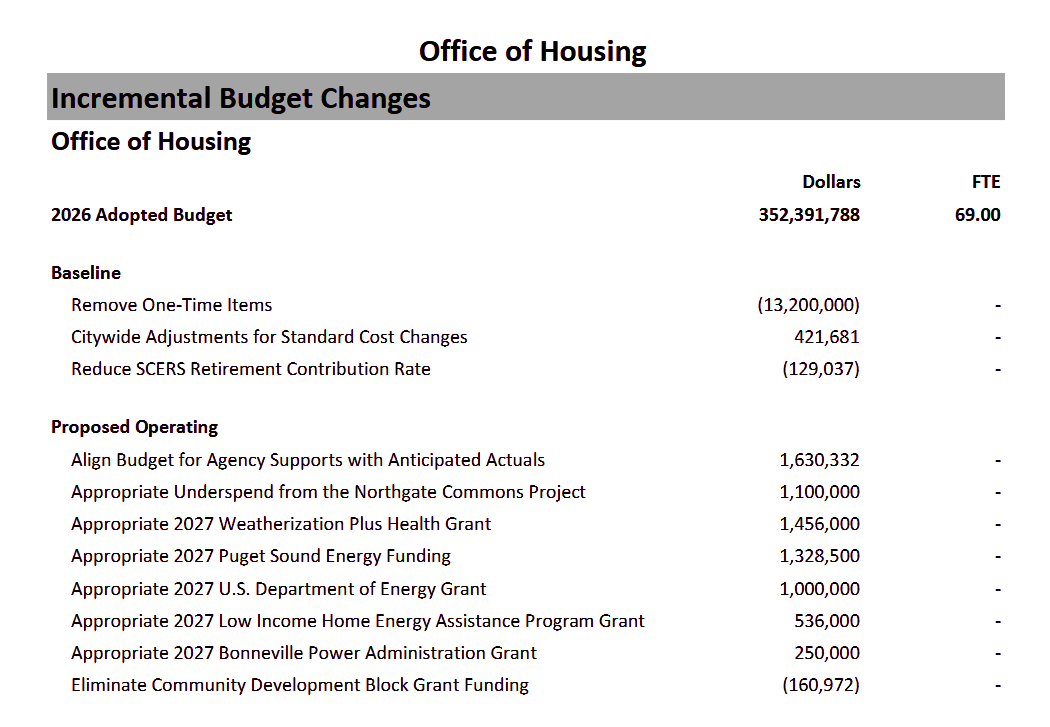
Incremental Budget Changes
This section details every change from the 2026 approved budget to the 2027 proposed budget, starting with summary tables that outline line-item changes and the staffing Full-Time-Equivalents associated with the change.
The categories of different items include but aren’t limited to:
Baseline
Proposed Operating
Proposed Capital
Proposed Technical
All changes are then described with a narrative rationale with the impact on staffing noted. These give us context on what shifts are being made and what adjustments are technically necessary for the continued operation of programs facilitated by the office or department.
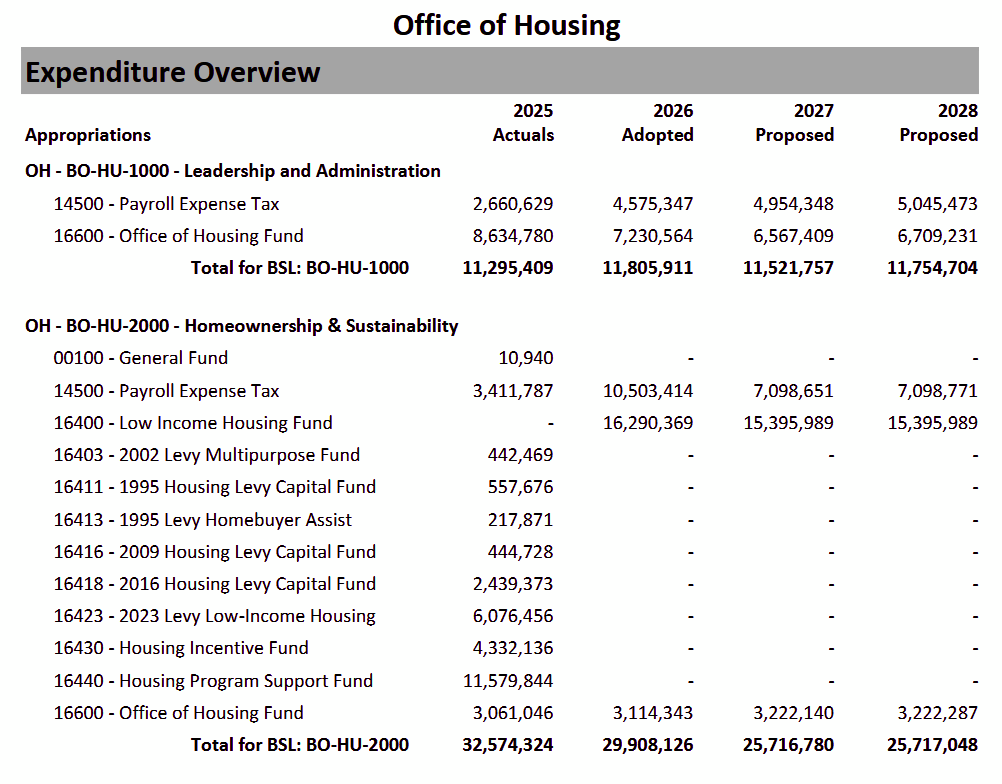
Expenditure Overview
This section lays out the budget summary levels that each office or department spends on, and shows how much money is being appropriated for each fund into the different programs. In this case, a program is referring to “A group of services within a department, aligned by common purpose”.
It lays out each of the budget summary levels in a table, and shows how much money is coming from each fund source for the following columns:
2025 Actual Budget
2026 Approved Budget
2027 Proposed Budget
2028 Proposed Budget
It can be looked at similarly to the ‘Budget Snapshot’, except in far more granular details (budget summary levels, all funds itemized).
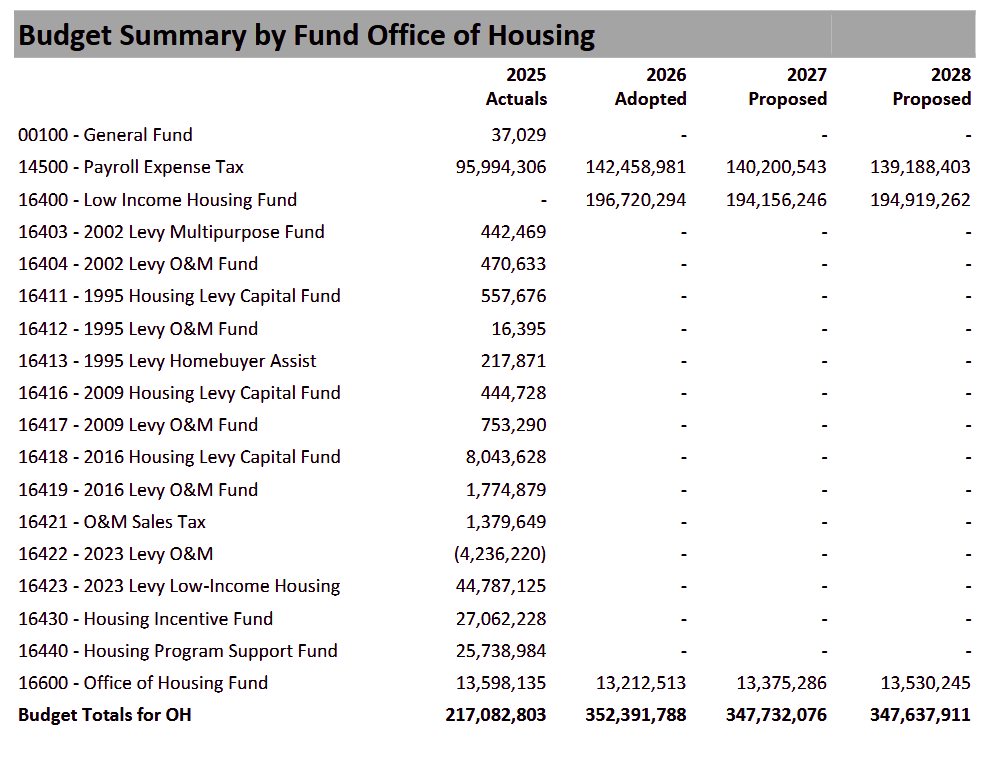
Budget Summary by Fund
This section shows how much money, in total, is appropriated for the office or department from each fund that provides funds to the entire office or department, for the following table columns:
2025 Actual Budget
2026 Approved Budget
2027 Proposed Budget
2028 Proposed Budget
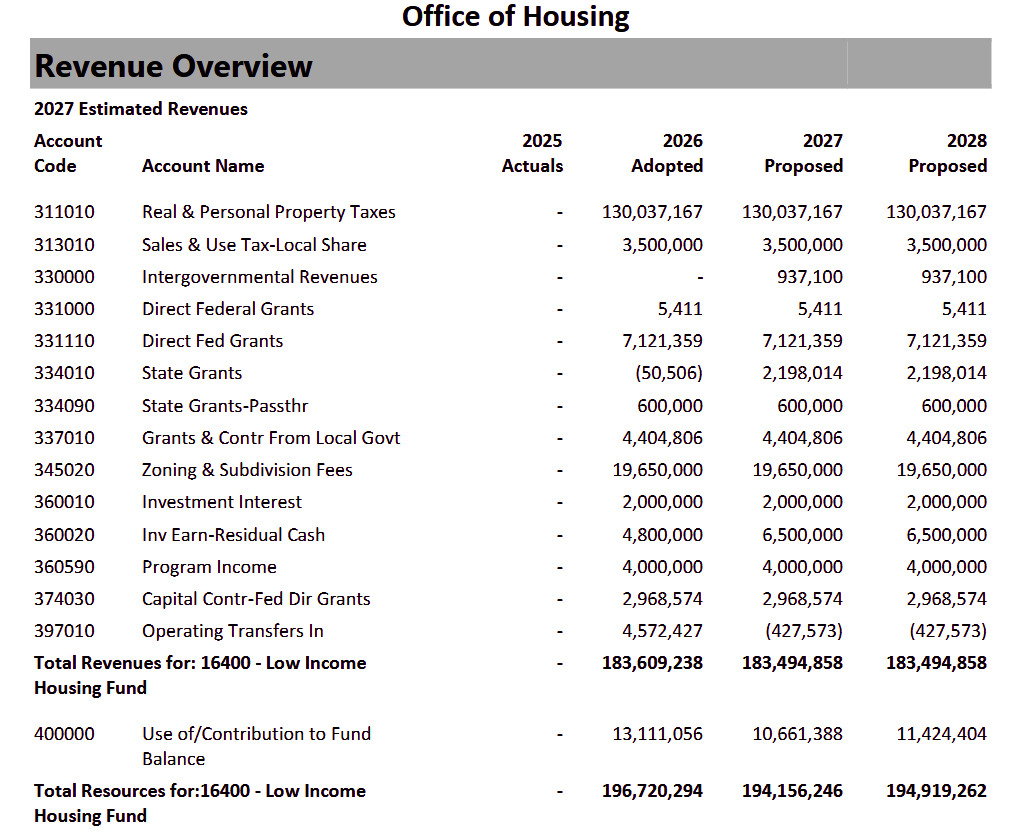
Revenue Overview
Not all offices or departments have this - some departments do not generate their own revenue. For offices or departments with a revenue overview section, this works similarly to the budget summary by fund, except it’s a summary of accounts that go into specific funds.
I admit - this one involves too many specifics for me to be comfortable drawing any meaningful data points from, until I’ve had a chance to speak with the experts on how these categories map onto city functions.
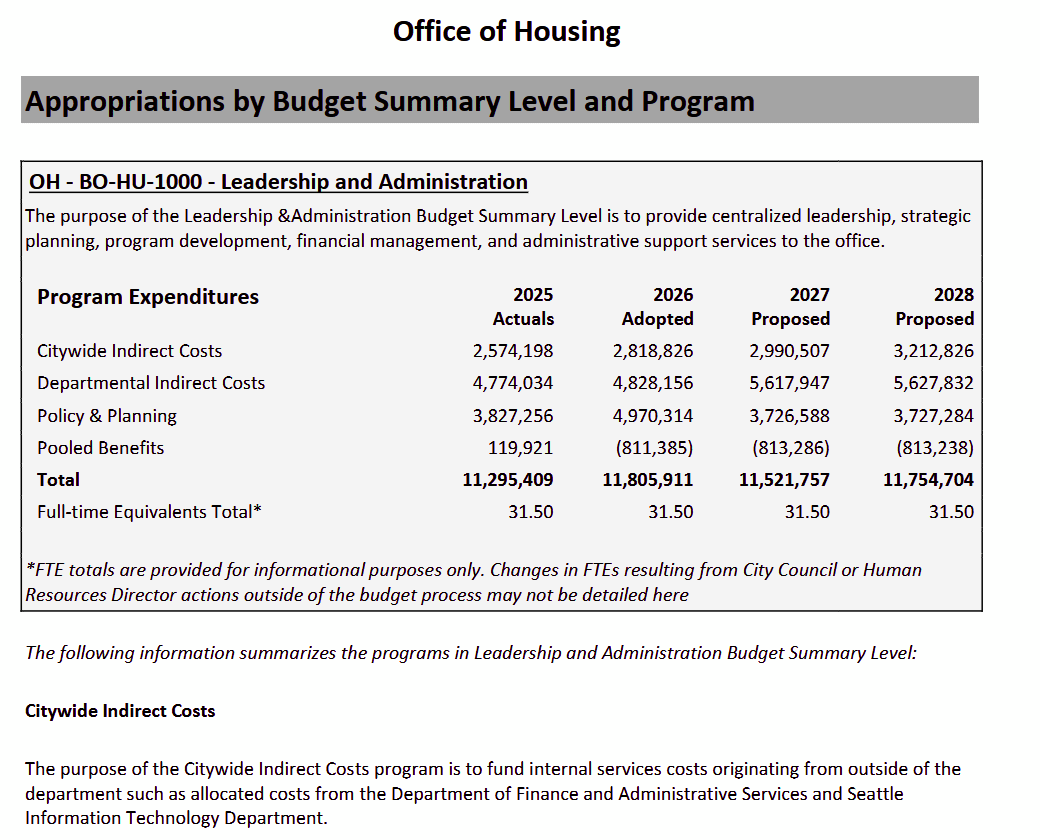
Appropriations by Budget Summary Level and Program
This goes into detail on each of the budget summary levels. These are the top-level buckets of programs that are funded by the City of Seattle budget. This section of the budget document gives a narrative of each of the programs and what funds are appropriated for each of the programs nested under their budget summary level.
What does it matter, and what’s next?
If we want to understand what the City of Seattle - and what its Sister City, Haiphong - are functionally accomplishing based on their structures, and we want to compare the two, we need to have a good handle on:
What is a function of the City?
What is the structure by which the City performs functions?
What are the outcomes of these functions?
The budget helps us answer bits of both of the first two (and a strange portion of the third. It lays out the structure of departments by budget summary levels and programs, which feed directly into what departments are doing (functions) and how the city is staffed and oriented (structure). For offices or departments that generate revenue, there’s actually some anticipated outcome from city functions, right in these budget documents.
The following is very inaccessible:
While Cities are not for-profit entities, revenue generation can be a valid outcome to track, especially when one considers the impact financial instruments funded through department-level revenue generation has on The City of Seattle’s access to debt and to insurance markets. If we can ever dive into the way the Preservation and Development Authorities work in the City of Seattle, we’ll see that the City’s own creditworthiness can directly or indirectly impact these semi-independent authorities that are headed by City of Seattle Boards and Commissions.
Back to more accessible:
From the documents we looked at in this edition, I’ll be able to get a lot of valuable data. It’s important to know whether an office or department generates revenue or not, or if it has a capital budget or not. Even having a list of every proposed budget year how each office or department defines its ‘programs’ will be very useful for mapping structural changes over the years and getting a snapshot.
It’s exciting to notice that these programs don’t cleanly map onto division or staffing structures. This means that there are forces outside of budget that determine how staff are arranged, which likely leads to mismatches between “program” and “function”.
Now that I’m back in the saddle, I’ll update my database on each department and office to include some of the facts from these budget documents (such as the binary “is revenue generating Y/N?”, Has Capital Budget Y/N?”) and develop a table of projects, budget summary levels, and the offices or departments that they fall under. Often times the work of going through each one uncovers patterns or quirks that lead to greater understanding.
The best way to keep up with further conversations is to be a subscriber to The Lanyard Board, and to check out The Lanyard Board on social media.
Thanks for reading The Lanyard Board! Subscribe for free to receive new posts and support my work.