

Housekeeping
This week, it’s Haiphong again. This week feels dryer than usual, but I promise the content is interesting, especially because the contours of lessons we can learn from the organization of Seattle and Haiphong’s governments are starting to take shape. Over my time in Vietnam, I have been astounded by the rapid change everyone has gone through for the past 30 years - operationally, it’s a marvel. Likewise, Seattle has become a place of safety and innovation, and when I think about the lessons that can be shared across the Pacific Ocean, it’s hard not to get excited!
Weekly Roundup
If you’re interested in travel pics and a few lines of narrative, feel free to check out the Instagram - for now you need to request access, but I’ll admit anyone, so don’t be shy!
https://www.instagram.com/thelanyardboard/
New Favorite Sources
None this week! I’ll be including lots of sources next week for the research I’ve been doing (links to the laws and so forth).
New Resources
This section will provide links to resources such as infographics that have been produced in the past week that are useful for understanding, mapping or working with City of Seattle stuff, broadly.
Changes to the blog! If you go to the homepage (https://www.thelanyardboard.com), you’ll be able to find tabs for resource infographics & weekly editions.
Organization Structure - Haiphong Part II
With the end of my first period of being in-country for Vietnam, I wanted to provide a clear breakdown of the structure of Haiphong’s Municipal Government.
For the time being, my analysis will have a few notable exclusions, which will be layered in over time as the analysis develops (if only for establishing good controls). I’d like to name them at the top, because I also think that independent research by the reader could be interesting. The main factors excluded from the analysis (for now) are;
The MTTQ, or the Vietnam Fatherland Front. This is a structural element of Vietnamese Society that is public in nature but not government - there’s nothing that maps cleanly onto it functionally or structurally that I have identified in American socio-political life. Analysis of its role will be easier when the role of the municipal government is well-characterized.
The governing political parties in the US and Vietnam. While they do structurally influence the shape and direction of policy and governance, and there are fascinating structural realities behind how the party is organized in Vietnam when compared to American party governance, it’s similar to the MTTQ in that it’s difficult to analyze without risking making apples to oranges comparisons.
The Judicial bodies in the US and Vietnam. This is just a structural reality both countries contend with - the courts are on separate parallel tracks in many ways to the governance of cities. Sometimes court rulings will create changes that influence policy in cities, but it’s marginal enough that it makes sense to focus in on the legislative and executive apparatuses of the two cities in question.
Relationships between local agencies and higher tier agencies of the same type. This will be necessary to look at by the end of this research project, but the heterogeneity makes this a monumental task that should be taken systematically after mapping out the structures of the municipalities. For example, mapping relationships between ‘Seattle Department of Education and Early Learning’ with WA State’s “Office of the Superintendent of Public Instruction” and with the USA’s “Department of Education”. This will be necessary because one of the key differences of Vietnam’s Municipal Government is that its department-level agencies have direct relationships and lines up to the national ministry-level agencies, and receive guidance, directives, rules, etc. from them, making the work of City Governance intrinsically linked to larger systems. This is true in the USA too - many of the funds the City uses are federal or state funds that come in the form of strict grant-reporting relationships that create similar ties that take different forms. I’ll look at these, but only after the skeleton has been constructed.
With these caveats in place, it’s a good idea to dive into what Vietnamese cities are made of, using the example of the Haiphong department of construction.
Form of Government & “Branches”
Vietnamese cities, at first blush, take a very recognizable form when comparing them to American cities. At the top, there’s a People’s Council (Hội đồng nhân dân (HĐND)), comprised of elected representatives from all over the city. The People’s Council is tasked with legislating, as well as oversight of the executive departments. The People’s Council also elects the head of the executive ‘branch’ of the city, known as the People’s Committee (Ủy ban nhân dân (UBND)).
This feels awfully similar to the role of City Councils in America that employ a council-manager form, especially when thinking about oversight systems like what we know from the City of Seattle (where city councilmembers have a caseload of departments underneath the mayor that they have oversight of).
It’s tempting to just call it there. It’s like a mayor-council format, with legislative and executive bodies that keep most of the administrative power in the hands of the executive, but absolute oversight and appointment power in the hands of the democratically elected legislative.
Where this becomes problematized is that in Vietnam, being a People’s Council-member is a part time job.
This means that farmers, teachers, doctors, low, middle and high-ranking members of the executive government - they are all able to become council-members through the elections, and in each election and council you see a great diversity of backgrounds. Unlike in a place like Seattle where council-members often do have a background in diverse fields (possibly biasing towards those with public service experience already), people do not renounce their former title and job when they become council-members. They live their lives as normal, and attend regular meetings of the council, but at a much lower frequency than what we see in the City of Seattle.
This also means that the act of being in the executive government and a councilor blurs the lines of a simple ‘balance of power’. If you ask a citizen of Vietnam about the local government, they will almost certainly imagine and be talking about the UBND (People’s Committee) rather than the People’s Council (HDND), because it’s this executive and administrative body that performs the work of governance. A great example of how this differs is that there is an executive department in Haiphong that is dedicated to researching, writing, and proposing legislation. This means that even though the People’s Council has legislative power, the People’s Committee is able and well-resourced enough to define its own evolving machinery, where the City of Seattle’s Executive Departments have historically often relied on acts of Council to establish them and make large structural changes.
One plausible interpretation, besides the People’s Committee having more power in a ‘balance of powers’ framework would be that there’s just not much intended tension between the People’s Council and People’s Committee. In Seattle, we talk about Council and the Mayor’s Office as having separate priorities that overlap or exist in tension, and the resulting “City Government” being a series of compromises and joint projects. In contrast, the Haiphong City Government, and cities in Vietnam, may be intended to prioritize quick, decisive action in return for less of a rich top-level split of powers and responsibilities than what we see in Seattle (where the top-level split between its 4 ‘branches’ represent multiple reporting lines of paid full time staff). Much of what we would ascribe to our Legislative or Law Departments in Seattle (like writing laws) are sublimated under the executive.
Departments
This is probably the clearest commonality between Seattle and Haiphong’s Municipal Government. Within the Executive Branch, there are departments that split up the fundamental subjects that are administered by the City. Simple, right?
Yes and no. Departments (Sở) may operate in a similar way to how ours are in Seattle - a Chairperson (director) who is appointed, some deputy chairs, divisions within it - but the subjects that are covered tend to be very different. In fact, they are very different even when compared to Haiphong’s Government pre-2025 reforms. During the reforms, the Departments of the city merged until there were only 13 executive departments (including the office of the People’s Committee, the analogue to our Mayor’s Office).
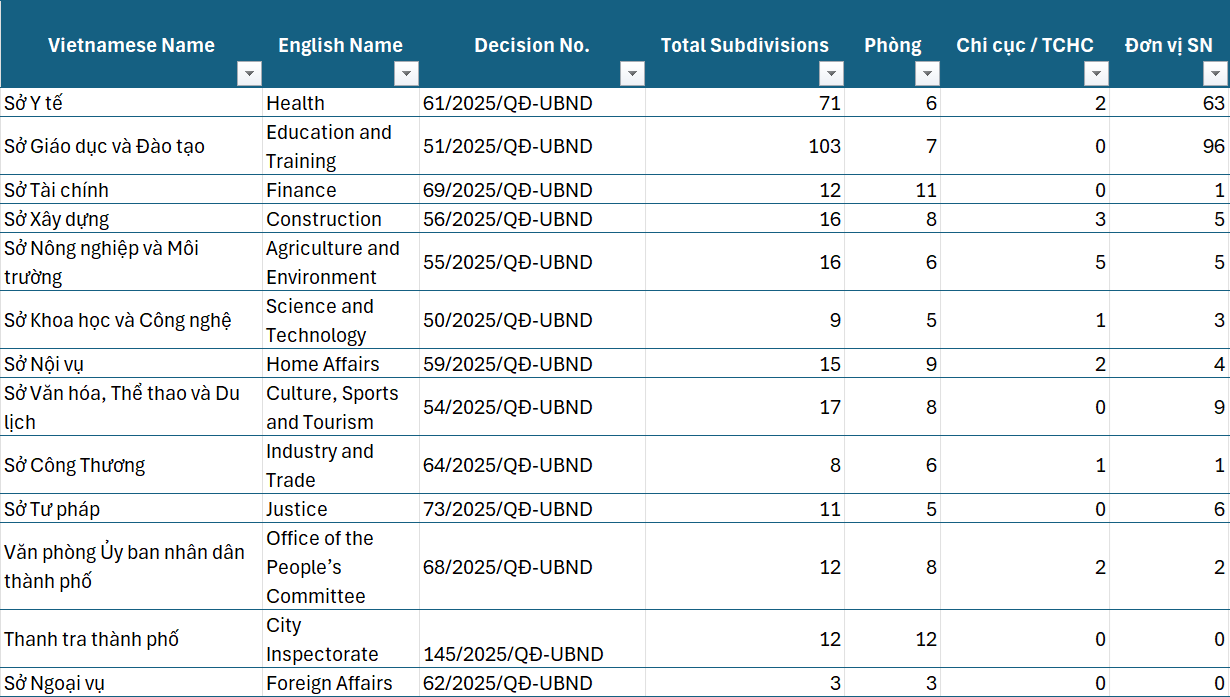
Before the merger, certain topics were not grouped together. There was a department of Transportation, and a Department of Construction - now, those are both within the remit of the Department of Construction. Information Technology was separate from Science, but now both are handled by the Department of Science and Technology.
This speaks to the magnitude of the reforms in 2025, and as I get deeper into this structure, it’s apparent that the changes have impacted far more than just ‘where people’s local offices are’ - the way city employees do their work is fundamentally different, and the way certain fields of service delivery are grouped together is incredibly different. For the research, this creates some complications. On one hand, there is a clear before and after period of the intervention that can be analyzed to understand richly what the effects of changing department structures can be. On the other, it makes it impossible to compare current data to historical trends when talking about Seattle and Haiphong, because any pre-2025 data is going to be referring to a different system. None of this, however, is a major obstruction to the research, just something that needs consideration.
Underneath the departments, you actually have a few categories of subdivision that have notable similarities and differences with Seattle. The table above lists all of these categories, and the number of these categories under each department.
Division level
Underneath the department level is what we might call the division level. Divisions (Phòng) are the typical ways each department structures itself, very similar to the model of Seattle’s executive departments. The average for Haiphong’s departments is 7 divisions per department, but there are other types of organizational entities that report directly to departments, placing them at the same administrative level to divisions.
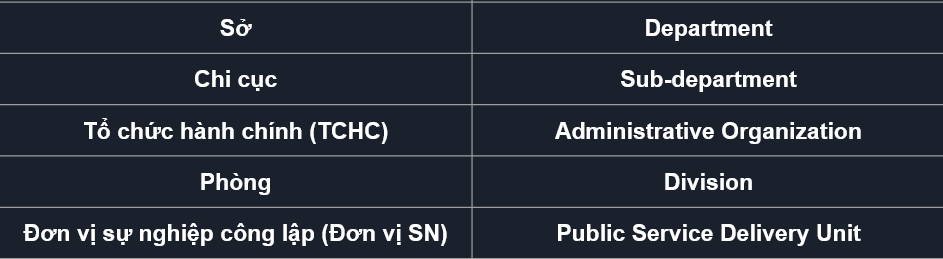
At this level, we have;
Divisions (Phòng), the ordinary structure for city staff working in the executive for programs and service delivery
Sub-departments (Chi cục), special bodies that have a lot more autonomy and are likely to have special functions that mean they need to be legislated separately
Administrative Organization (TCHC), similar to sub-departments, these just sometimes are given different names in the organizing legislation, but fundamentally are just bodies that report to the department that have specialization and autonomy
Public Service Delivery Unit (Đơn vị sự nghiệp công lập (Đơn vị SN)), these are (usually physical) facilities and organizations that are directly run at a site or programmatic level - like schools and clinics/hospitals
There’s a massive diversity of how each department is organized based on scope. Departments that do a lot of direct community service (like running hospitals and schools) have more Public Service Delivery Units, as a recognizable trend. There are also early signs that different departments have different strategies for their mergers - in some cases, the divisions are separated in such away that the joining department isn’t disrupted, while in other cases, some of the operations seem to have blended between previously unrelated departments.
Department-Level, Track #2
While we’re looking at the executive government of the City of Haiphong, one tricky structural fact looms large. Reporting directly to the People’s Committee of the City of Haiphong are… 114 People’s Committees of the local commune-level governments that are comprised of wards, communes and special zones. These People’s Committees have their own staff (and budget assigned to them by the regular budget), and underneath these are commune-level departments. Under those departments, further sub-divisions.
We’ll look at this in a separate article, and then come back to create a model that recognizes the City-level administrative departments, the lower-tier units and their administrations, and then other bodies that report directly to the City-level People’s Committee (such as Haiphong University, or the Haiphong Economic Zone Authority). The exact reporting structures of ‘commune government’ to ‘city government’ are still a bit opaque to me, but I should be able to find a source or otherwise characterize it in a way that makes sense.
In future weeks, we’ll also look at some specific examples of these departments at the division level, and begin mapping the division level in the City of Seattle as well to get a better sense of structurally what is considered a top-level department distinction and what is a sublimated division distinction, as I suspect that will be fertile ground for identifying key comparisons.
The best way to keep up with further conversations is to be a subscriber to The Lanyard Board, and to check out The Lanyard Board on social media.
The Lanyard Board is supported by readers like yourself. If you can, please support the project on Ko-Fi and tip the suggested amount of $2 for every month you feel a spark of enjoyment, insight or curiosity from The Lanyard Board.
Thanks for reading The Lanyard Board! Subscribe for free to receive new posts and support my work.